Paperback
You know roughly what you have. You don't know what it means.
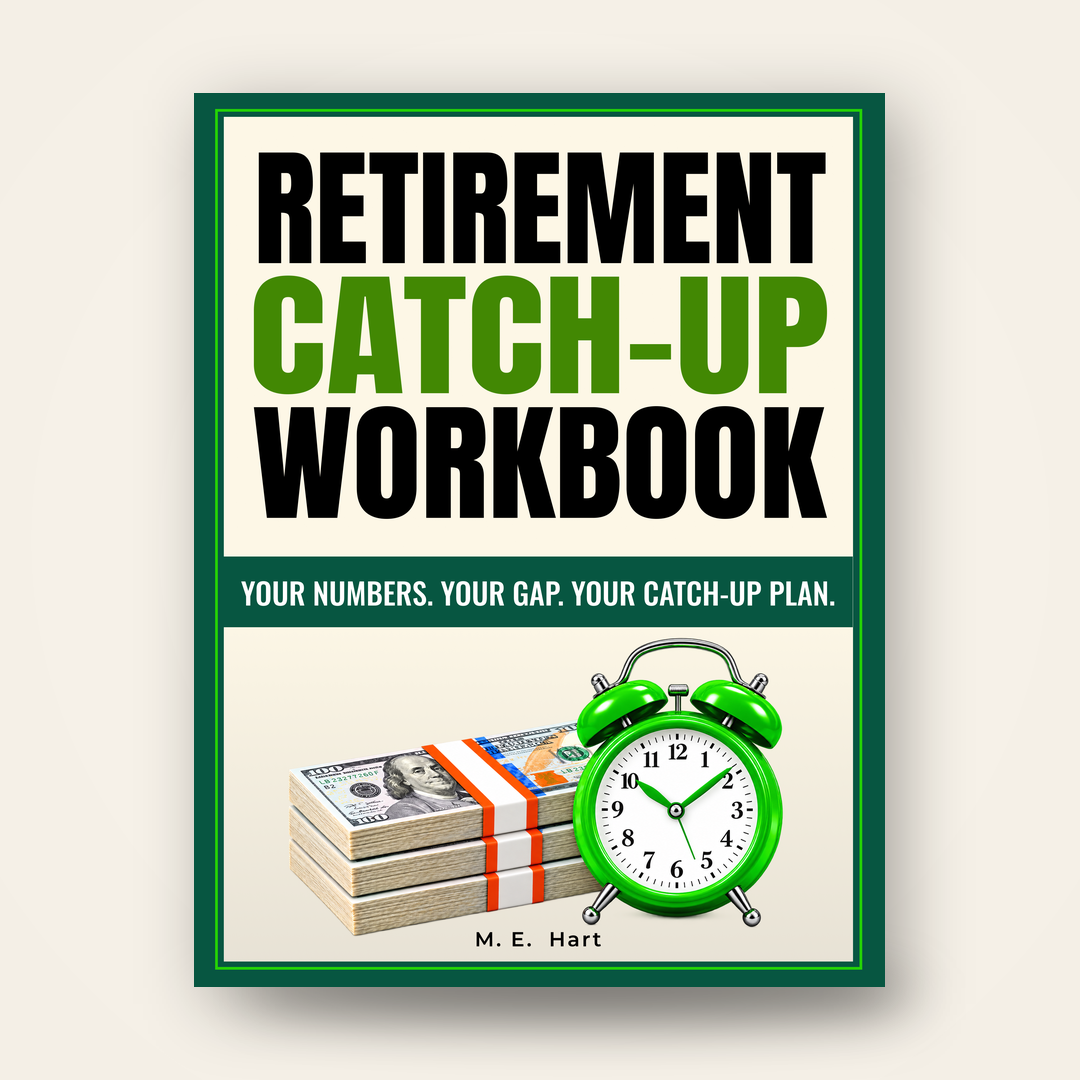
The book explains it. This is where you do the work — on paper, in your own handwriting, at your own kitchen table. Forty-six pages of blanks, and one number they all converge on.
Retirement Catch-Up Workbook
- ✓What you spend now, and what changes when work stops
- ✓Your Social Security, copied off your own SSA statement
- ✓Your rough monthly gap, on one facing spread
- ✓The same spread filled in, as a worked example
- ✓Three levers you test yourself, one page each
- ✓A one-page Catch-Up Plan you date and sign
One paperback. Free US shipping.
Gives you a true picture of where you are financially
Determine your financial gap to retirement … adjust your course as needed
This is an excellent workbook! I will be utilizing this in the near future!

Written by
M. E. Hart
Retired product and customer experience leader with a career in healthcare and insurance.
She spent years translating complicated systems, paperwork and decisions into consumer experiences people could actually use. Retirement In Order applies that same approach to aging, retirement and getting important affairs organized.
Try this first
Five blanks you can't fill in from memory.
Every one of these has an answer already. Most people carry a version of it around in their head, and the version in their head is the one they've been planning on.
- What did an ordinary month actually cost you?
- What does your Social Security Statement actually say — not what you remember?
- When does each payment you owe stop?
- What will coverage cost between your last day and 65?
- What's the number left when you subtract one from the other?
If you answered any of them with “about,” that's the figure you've been retiring on.
What writing it down changes
| In your head | On the page |
|---|---|
| A figure you remember from the last time you looked | The figure off your own statement, with the date you copied it |
| The budget you meant to keep | The month you actually had, added once |
| Every payment feels permanent | Each one with the month it ends beside it |
| Coverage to 65 is a worry without a number | A line item — or UNKNOWN, if that's the honest answer today |
| A gap you estimate differently every time | One number, on one spread, with a worked example opposite |
Whichever blank you couldn't fill in is what this workbook is for.
For the reader who's done reading
A number you wrote down yourself is the only one you'll argue with.
You can read a good retirement book, agree with all of it, and put it down with nothing on paper. Six months on, the only figure you can still quote is the one from the search bar — and it was never yours.
This is the other half. Five parts, forty-six pages, every one of them a writing surface: where you stand today, what your gap is, what can still change, what still needs an answer from someone who isn't you, and the plan you carry out of it.
UNKNOWN counts as an answer here. Page 3 says so and the pages are built to take it, because a blank you wrote down is a blank you'll come back to, and a blank you skipped is one you'll forget you left.
From the author
Watch: the number this workbook replaces
A million dollars, ten times your salary — that was never a figure you could act on. The two that replace it are the ones you write on page 14, and this is where they come from.
- ✓ The two figures that replace the million-dollar number
- ✓ Why five years still changes the answer, even if saving more won't
- ✓ Captioned · 24 sec · watch right here
Peek inside
See the actual pages
Not descriptions of the pages — the pages. Swipe through, and tap any one to read it full size.
What changes when they arrive
This is what's on paper by the time you put it down — in your own handwriting, dated. One 8.5 × 11 paperback, 46 pages, free US shipping.
Have your own gap on one spread, not a guess that moves
What a retirement month will cost, what genuinely counts as paying for it, and the number left over — your own figures on one facing spread, with a finished example printed opposite.
- Six pages of arithmetic in forty-six, all of it add a column and subtract twice.
- UNKNOWN is a real answer, and the totals show you which unknowns matter.
Parts 1 to 3 — where you stand, what you look up, your gap
Have tested three changes yourself instead of reading a list
Six places a plan can move are marked. You pick three, work each one on its own page, then a page for what all three together would do to your number.
- One lever per page, in your figures, not a household from a book.
- What the three together would change — marked, not added, because levers overlap.
Part 4 — the three levers you test
Leave with a plan you dated and signed
Eight actions, each with its own next step, narrowed from your own numbers — on one page carrying your work-stop date, your claiming date and the date you'll come back to it.
- Fourteen red flags you can check without research, and a worry turned into a real question.
- The same eight actions tracked across twelve months.
Part 5 — the plan you sign
Start tonight
You don't need the workbook to start the workbook.
Three things you can do before the parcel arrives, on any piece of paper.
What last month really cost
Write down what last month cost you. Not the budget you meant to keep — the month you had.
Your Social Security estimate
Log in at ssa.gov and copy your estimate at your full retirement age. Not the figure you remember, the one on your record.
The difference between them
Put the two on the same page and subtract one from the other.
That difference isn't your gap yet, but it's the first honest look at it — and it's the number page 14 opens on.
Your own number is one afternoon away.
One paperback. Free US shipping.
What readers say
Every review we have is below — nothing is filtered out.
“Good materials included”
If you are looking for something to help prepare you for retirement this book is wonderful. The forms are great information and gives you a true picture of where you are financially if you needed to retire or where you will be when you plan to retire. I recommend this book
Becky, verified reader · Sep 2026
“Determine your financial gap to retirement to prepare and adjust your course as needed.”
Great way to personally visualize your personal situation when preparing to transition to retirement. Would be helpful to use to determine were your at and try to find solutions to short falls or even maximize your savings now for future you.
Gypsy, verified reader · Sep 2026
“Great workbook for soon to be retirees!”
As a person that has to write down everything and see it on paper, this is an excellent workbook! I will be utilizing this in the near future! One thing I had a question on is in the expenses it says family support. That could be more detailed as I was thinking is that if we borrow money to family or is that like child support or alimony.
Mary, verified reader · Sep 2026
Where your figures come from
Your numbers, from the places that hold them.
Nothing in this workbook is estimated for you. Where a line needs a figure from an agency, the page says which one and what to ask for, and UNKNOWN is a legal answer until you've been — so no printed number here goes out of date on you.
- Social SecurityYour record and estimate at each age
- MedicareWhen coverage starts, what it covers
- HealthCare.govMarketplace plans and financial help
- IRSContribution limits and withdrawal tax
Good to know
Common questions
Do I need the book to use the workbook?
No. The workbook stands on its own — every page tells you what to write and why it matters, and the one place it needs a judgement call it prints a worked example opposite. The book is where the reasoning lives: why a claiming date isn't free, why housing has two separate effects, what a coverage bridge to 65 actually costs. Plenty of people do the workbook first and buy the book when a lever test turns out to be the interesting one.
How much arithmetic is there really?
Six pages of it in forty-six, and all of it is addition and subtraction — add a column, subtract twice. There is no compounding, no growth assumption and no formula to look up. The rest of the workbook is ticks, dates, short written answers and one signature.
What do I do about a number I don't know?
Write UNKNOWN. That is a real answer here and the pages are built to take it — page 3 makes it the first of six rules. The totals then show you which unknowns are actually holding up your plan, so instead of a tidy page with guesses on it you get a short list of things to go and find out. Part 4 is where those become questions with a name against each one.
Is this a budgeting workbook?
No, and it is deliberately not one. It asks what you spend in an ordinary month once, as a starting figure, and never asks you to track a category or keep anything up week to week. What it is interested in is the difference between what your retirement months will cost and what will be paying for them.
Forty-six pages. Is that enough for the price?
That is the fair question, and the honest answer is that the page count is the point. Two hundred pages of blank trackers get filled in for three weeks and abandoned; this is the shortest route from the figures you already half-know to one gap number and a signed plan, and there is nothing in it you fill in twice. It is 8.5 × 11 with generous writing rules, so a page here holds what four pages of a pocket planner would.
Can my spouse and I share one copy?
Yes — the spending, coverage and gap pages are written for a household rather than a person, and there are separate lines for each of you where the figures differ, like the two Social Security estimates and the two work-stop dates. If you both want your own lever tests and your own signed plan, buy two.
What format does it come in?
A 46-page 8.5 × 11 paperback, black and white, printed when you order and mailed to you — free US shipping, about two weeks. Paperback is the only edition and always will be: every page is a writing surface, and a fill-in workbook doesn't reflow onto a screen.
Who is this workbook not for?
Anyone already retired. Most of what it asks you to test closes on your last day of work, so the levers it prices are the ones you no longer hold. It is also the wrong buy if you want someone to tell you what to do with the answer — it produces your number and your three tested changes, and then sends you to the person licensed to advise on them.
Is this financial advice?
No. It is an educational workbook: it organizes your own figures and your own questions, and it names no products, funds or providers. Contribution limits, benefit rules and tax thresholds reset annually, so check any figure against the agency or plan that holds it — the workbook routes you there rather than printing a number that expires.
What if it isn't right for me?
Each book is printed for you one copy at a time. If your parcel turns up damaged or misprinted, send a photo within 30 days and we ship a replacement free — you keep the flawed copy. Because every copy is made to order, we can't take a book back once it has shipped. Contact details are at the bottom of this page.
Your next step
Write your number down, while the levers are still yours.
Forty-six pages of blanks, and one number they all converge on.
Your spending, your SSA figure, your debt end-dates and your gap on one facing spread — then a plan you date and sign. One paperback, posted to you.
What the money buys isn't a workbook. It's the afternoon you finally do the arithmetic instead of carrying it around.
One paperback. Free US shipping.
You may also be interested in


Start getting retirement in order — one simple checklist at a time
Free quick-start checklists to help you organize the practical parts of retirement: what to gather, what to decide, and what to write down first.
- What to gather
- What to update
- What to share with family
Almost there — check your inbox.
We just sent a confirmation email. Click the link inside and your free download lands right after. (If you don't see it, check spam or promotions.)
 Retirement Catch-Up Workbook$25.99Paperback
$25.99Paperback
