Paperback
You can't save your way out of it in five years. You can change what those five years have to fund.
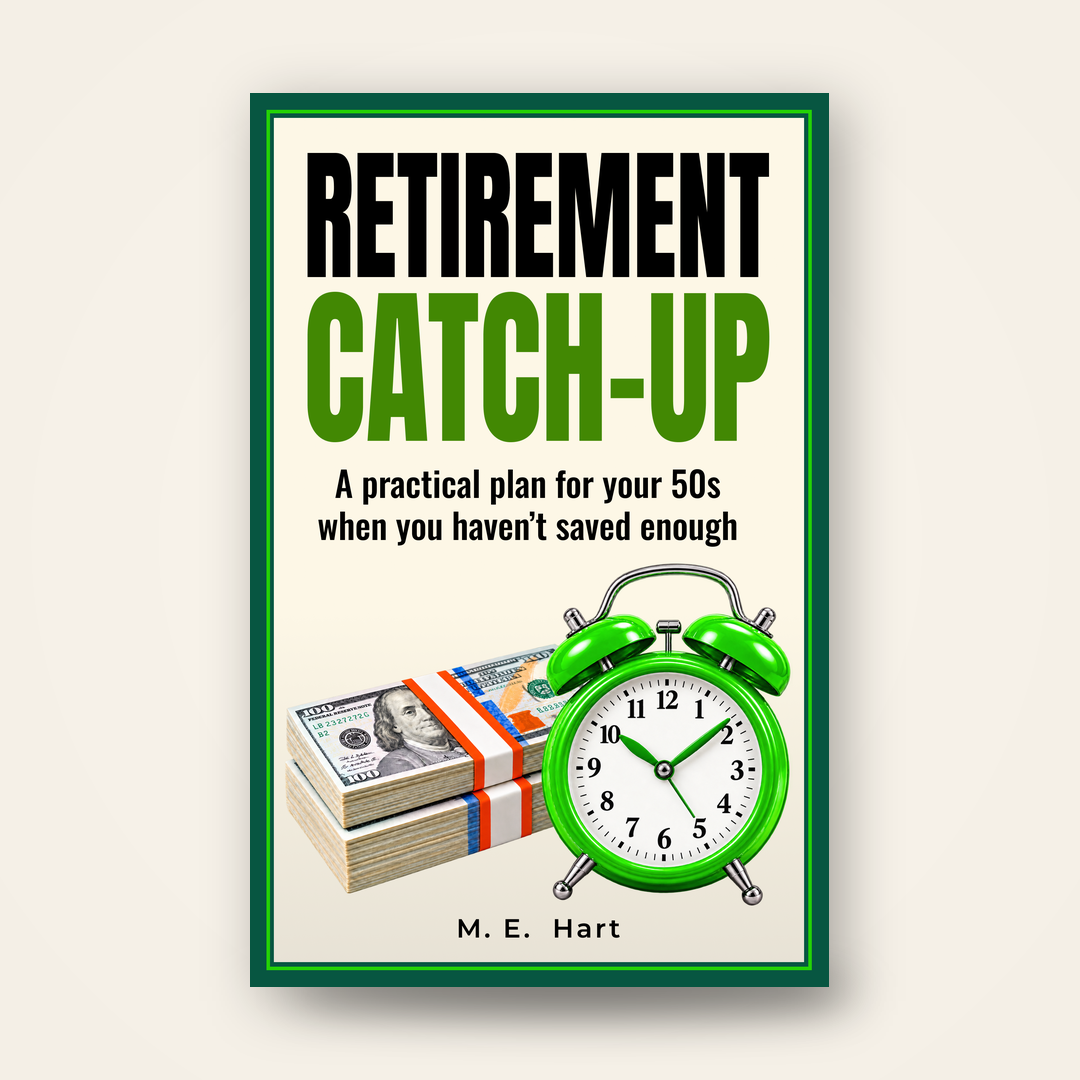
A six-figure shortfall is not a plan. A monthly number is. This book works out what you're actually short, prices every lever on its own, then closes on a one-page sheet.
Retirement Catch-Up: When you're behind
- ✓What your savings actually produce a month — and what they don't
- ✓Why a later claiming date isn't free, and when it still wins
- ✓The health insurance bridge between your last paycheck and 65
- ✓Housing as the biggest lever, and its two separate effects
- ✓Five households worked end to end, every change priced
- ✓The one-page plan Chapter 19 closes on, shown filled in
One paperback. Free US shipping.
Starting later does not mean giving up
Examples and comparisons to make those decisions
This actually gives you a practical plan with resources

Written by
M. E. Hart
Retired product and customer experience leader with a career in healthcare and insurance.
She spent years translating complicated systems, paperwork and decisions into consumer experiences people could actually use. Retirement In Order applies that same approach to aging, retirement and getting important affairs organized.
The math
Not one heroic move. Three ordinary ones, priced.
Denise is 57, single, renting, earning about $52,000, with about $40,000 in a 401(k). She's one of five households Chapter 14 carries from a starting gap to a resulting one, with every step of the arithmetic on the page.
Three moderate changes took this household's gap from $1,370 a month to $860.
Yours won't be these numbers. That's the point. Chapters 2 to 4 are where your own spending, your own SSA figure and your own gap get worked out, and Chapter 19 closes on a one-page plan.
Claiming ages, coverage rules and contribution limits come from SSA, Medicare, HealthCare.gov and the IRS — and the book prints the year it verified each one.
| Denise, 57 · worked in full in Chapter 14 | Before | After |
|---|---|---|
| Monthly retirement income | $1,830 | $2,190 |
| Monthly spending | $3,200 | $3,050 |
| Monthly gap | −$1,370 | −$860 |
| What moved it | ||
| Stopping and claiming at 67, not 65 | +$260 | |
| Ten years of $250 a month more saved | +$100 | |
| A retirement rent $150 lower | +$150 | |
Illustrative figures.
For the fifty-something who ran the numbers and stopped
Behind is not a verdict. It's a number with a cause.
You typed some version of it into a search bar — how much should I have saved for retirement at 55 — and the answer came back in under a second: a multiple of your salary, or a round million dollars. You read it, did the subtraction, and stopped.
This book does not open with encouragement and it does not relitigate the years behind you. Your past has exactly one job here: it matters where it still affects a number you can change, and nowhere else. What follows is four chapters that replace the benchmark with your own two numbers, nine that price every lever you still control, and five households worked all the way through.
From the author
Watch: the number that was never yours
You ran the numbers once and stopped. A million dollars, ten times your salary — that was never a target you could act on. The useful question is smaller, and it starts with what your months will cost.
- ✓ The two figures that replace the million-dollar number
- ✓ Why five years still changes the answer, even if saving more won't
- ✓ Captioned · 24 sec · watch right here
Peek inside
See the actual pages
Not descriptions of the pages — the pages. Swipe through, and tap any one to read it full size.
What changes when they arrive
This is what's worked out by the time you put it down — your figures, not a rule of thumb. One paperback, 204 pages, free US shipping.
Know your gap in dollars a month, not in multiples of your salary
What your months will cost against what your savings and benefits actually produce — two figures that are yours, and the distance between them. The benchmark was answering a different question.
- Take stock in an afternoon — the accounts, the statements, what you owe — without it turning into three weekends.
- What a lump sum genuinely produces each month, and what it doesn't.
Chapters 2 to 4, the benchmark replaced
Know what each change is worth before you make it
A later claiming date, the mortgage, the coverage bridge to 65, a smaller house, a debt that ends — each priced on its own, in dollars a month, with the cost of the change counted too.
- Why waiting to claim isn't free, and when it still wins.
- Housing's two separate effects, and why they don't simply add.
Nine chapters, one lever each
Leave with the one-page plan you'd take to a professional
Five households worked from a starting gap to a resulting one, then Chapter 19's one-page plan — the number most people never work out before they sit down with an adviser.
- What not to do when the numbers create urgency.
- Real help without handing over a percentage of everything you have.
Every figure carries the year it was verified
Start this week
You don't have to close the gap this week.
Three things you can do before the parcel arrives. None of them needs the book open.
Your Social Security estimate, at two ages
Log in at ssa.gov and write down your estimate at your full retirement age and at the earliest age you'd actually consider. Not the figure you remember — the one on your own earnings record.
What last month really cost
Write down what last month actually cost you. Not the budget you meant to keep, the month you had.
When each payment stops
List every payment you make that has an end date — the mortgage, the car, the loan — and the month each one stops.
Twenty minutes, and the shortfall stops being a feeling. Those three figures are where every chapter in the book starts.
Work out what you're actually short, then price what moves it.
One paperback. Free US shipping.
What readers say
Every review we have is below — nothing is filtered out.
“An Encouraging & Practical Retirement Guide for Your 50s”
Retirement Catch-Up: A Practical Plan for Your 50s When You... is a reassuring and useful resource for anyone who has reached their 50s and realized their retirement savings may not be where they hoped they would be. What I appreciate most is the book's practical, forward-looking approach. Instead of dwelling on financial decisions that cannot be changed, it focuses on what readers can do now to improve their position. That perspective makes retirement planning feel less overwhelming and much more achievable. The book encourages readers to evaluate their finances realistically, establish priorities, make intentional decisions, and maximize the remaining working years. It also reinforces an important message: starting later does not mean giving up. There can still be meaningful opportunities to increase savings, reduce expenses and debt, reconsider retirement expectations, and create a more sustainable financial plan. I also appreciated that the subject is approached in a way that can benefit people who may feel intimidated or embarrassed about being behind. The emphasis is on developing a plan and taking consistent action rather than comparing yourself with where someone else believes you should be financially. This is an especially valuable resource for people in their 50s who want a clearer retirement strategy, including those who are rebuilding after financial setbacks or simply getting serious about retirement planning later in life. A motivating and practical guide that turns “I should have started sooner” into “What can I do starting today?” Highly recommended for anyone ready to take greater control of their financial future.
Shelanda, verified reader · Aug 2026
“A Practical Plan for Your 50s When You Haven't Saved Enough”
A million dollars, ten times your salary — is not a target you can act on. It was never yours. What decides whether you retire is smaller, and far more useful: what your months will cost, and what your savings and your benefits actually produce against that cost. The difference between those two figures is your gap, and a gap has a cause. A claiming date. A mortgage with fourteen years left to run. Coverage you have to buy before 65. A car payment that ends while you are still working, which is not the improvement it looks like. This book builds the comparison, names the cause, and prices each lever in dollars a month.
Joann, verified reader · Aug 2026
“Create a practical plan for your 50s as you head towards retirement”
Super informative but it can also be overwhelming with the amount of information! Read it slowly, take notes and go back and re-read if needed. If you think you are nearing retirement age though and feel like you haven't been saving enough or aren't adequately prepared then read this book and see where you can make adjustments in your life and start a game plan. The book gives examples and comparisons and also outlines a ton of resources and a practical plan for moving forward.
Verified reader · Aug 2026
Read all 6 reviewsHide reviews
“Review of Retirement Catch-Up”
This book was extremely helpful in understanding the ins and outs for what to do in the event you feel that you need to “catch-up” financially before you retire. There are so many factors to weigh when making these decisions, and this book provides examples and comparisons to make those decisions. Extremely helpful read for anyone thinking about retirement and concerned they may not have all of the financial plans worked out!
Erik, verified reader · Aug 2026
“Good resource material”
This isn't a last-minute oh let's save and go from there. This actually gives you a practical plan with resources and everything else that you will need that you can even start implementing earlier than in your 50s. This also gives you five plans to catch up on things that you could be missing or just need to know and need to do to prevent things happening in the future.
Bree, verified reader · Aug 2026
“Not what I expected but still loads of info”
Not what I expected from this book. Was hoping to get more of a chart type method of playing catch-up. LOADS of info and examples of dollars and how to approach playing the catch-up up game!! A bit overwhelming for me but I know that this information is valuable to a lot of folks. Although it isn't for me, I'm 250% positive it will be better used by others!! Kudos to the author for such a compilation and examples. There is a lot in this book.
Amy, verified reader · Aug 2026
Where the numbers come from
Every figure carries the year it was verified.
Claiming ages and credits are SSA's, the coverage rules are Medicare's and the Marketplace's, the limits are the IRS's — and the book prints the year it checked each one, because a retirement figure that ages without saying so is worse than no figure at all.
- Social SecurityEarnings record and claiming rules
- MedicareEligibility and enrollment periods
- HealthCare.govMarketplace plans and financial help
- IRSContribution limits and withdrawal tax
Good to know
Common questions
Who is this book for?
Someone in their fifties, still earning, who has looked at a retirement benchmark and at their own balance and found the distance between them frightening. It assumes you are working, that you have some runway left, and that nobody is coming with a windfall. It does not assume a spouse, a pension, or a particular household shape — five different households are worked through in Chapter 14, and one of them is a widow, one is divorced, one is a couple, and one is self-employed.
I'm 57 with far less saved than the benchmark says. Is it too late?
The honest answer is that you cannot save your way out of this in five years, and the book says so on the back cover. What you can change is what those five years have to fund. The retirement date, the claiming date, the coverage you buy before 65, the mortgage, the recurring costs and the accounts you stopped looking at all move the same monthly number, and several moderate changes together move it further than any single heroic one. None of the five plans in Chapter 14 reaches zero. Every one of them ends up somewhere better than it started.
Does it tell me what to invest in?
No, and that is deliberate. Every illustration in the book assumes zero growth, because a plan that needs a particular return in order to work is a plan resting on the one assumption you do not control. Chapter 17 is specifically about what not to do when the numbers create urgency — reaching for return, buying a guarantee without pricing it, and the other moves that look like catching up and are not. The book prices what you can move and hands the investment question to someone licensed to answer it.
How is this different from a retirement calculator?
A calculator gives you a target. This gives you a gap and its cause. Chapters 2 and 3 build what your savings and benefits actually produce each month, set it against what your months will cost, and Chapter 4 names why the difference is the size it is — because a claiming date is early, because a mortgage runs fourteen more years, because there is coverage to buy before Medicare. A cause is something you can price. A target is not.
Should I wait until 70 to claim Social Security?
The book will not answer that for you, and it explains why the usual advice to wait is stated too simply. A later claiming date raises the monthly benefit and also removes years of it, and the trade lands differently depending on whether you are still earning, whether a survivor benefit is in play, and what has to fund the years in between. Chapter 5 works the arithmetic in both directions; Chapter 12 comes back to it for pension survivor elections. Your own figures come from your Social Security Statement, and the book sends you there rather than quoting an estimate.
What about health insurance before Medicare?
Chapter 7 treats pre-Medicare coverage as a constraint on the retirement date rather than as a subject in itself — what the bridge costs, how the premium assistance rules interact with the income you draw, and why the coverage question often sets the date rather than the other way round. It is deliberately high-level. Health Insurance for the Solo Early Retiree, by the same author, takes up the coverage decision at length; nothing in this book depends on it.
Is this financial advice?
No. It is educational — a plain-English guide to the arithmetic, the levers and the questions, with every figure carrying the year it was verified and drawn from a primary source. Benefit, contribution and tax rules change, most of them every year, so the book routes you to the agency, plan, insurer or professional that holds your answer instead of pretending a printed figure settles it. Chapter 18 is about how to get real help without handing over a percentage of everything you have.
What format does it come in?
A 204-page paperback, printed when you order and mailed to you — free US shipping, about two weeks. Published under the pen name M. E. Hart as part of the Retirement In Order series.
Who is this book not for?
Anyone hoping for an investment answer. There are no funds, no allocations and no picks in 204 pages, on purpose — what you hold matters far less at this stage than what you spend, when you stop working, and when you claim. It's also the wrong book if you're already retired, because most of the levers priced here close on your last day of work. And if you're on track against your own numbers rather than a salary multiple, you don't need it.
How current are the figures?
Every dollar figure carries the year it was verified and comes from a primary source named in the text: SSA for claiming ages and benefit math, the IRS for contribution and catch-up limits, HealthCare.gov and CMS for the coverage bridge to Medicare. Limits and thresholds reset annually, so re-run your own numbers against the current year before you act on a lever.
What if it isn't right for me?
Each book is printed for you one copy at a time. If your parcel turns up damaged or misprinted, send a photo within 30 days and we ship a replacement free — you keep the flawed copy. Because every copy is made to order, we can't take a book back once it has shipped. Contact details are at the bottom of this page.
Your next step
Find your number, then decide what to do about it.
The gap, its cause, and every lever priced in dollars a month.
Two figures that are actually yours, the distance between them, and what each change is worth. One paperback, posted to you.
What the money buys isn't a book. It's the number you'd take to a professional, worked out before you pay one.
One paperback. Free US shipping.
You may also be interested in


Start getting retirement in order — one simple checklist at a time
Free quick-start checklists to help you organize the practical parts of retirement: what to gather, what to decide, and what to write down first.
- What to gather
- What to update
- What to share with family
Almost there — check your inbox.
We just sent a confirmation email. Click the link inside and your free download lands right after. (If you don't see it, check spam or promotions.)
 Retirement Catch-Up$26.99Paperback
$26.99Paperback
Retirement Catch-Up$26.99Paperback
$26.99Paperback
