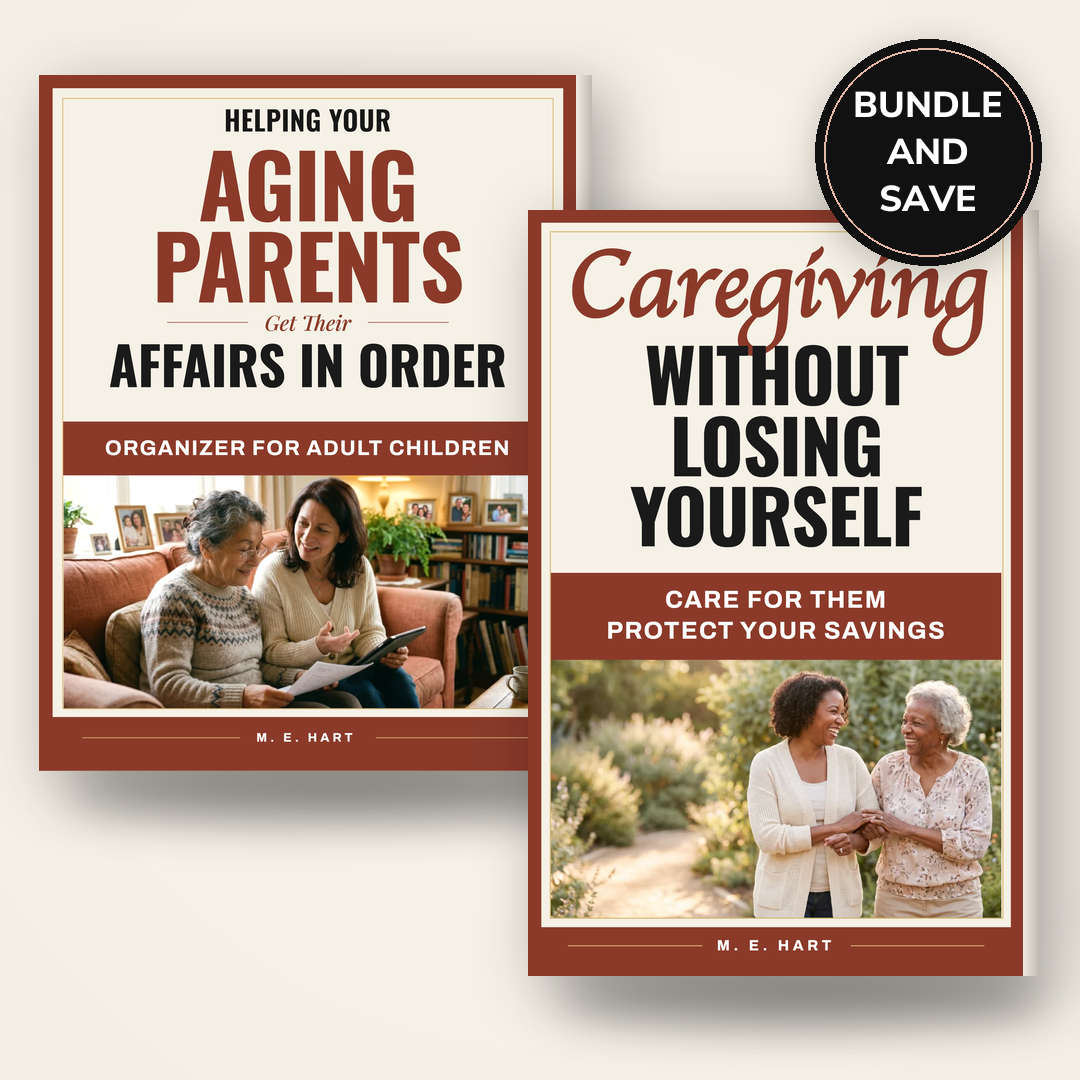
Your parents know where everything is — the doctors, the will, the accounts, who to call. One day, you may be the one who needs those answers. Finding them in a crisis can cost you hours and money you didn't need to lose.
It transforms an overwhelming subject into clear, manageable steps
JohnVerified reader · Aug 2026
It's ok, to set boundaries. It's ok to say no.
LhunterVerified reader · Aug 2026
My mom never took a day off and she got so worn out. She needed to.
DaniVerified reader · Jul 2026
Try this first
The worst time to reconstruct your parents' life is when something has already happened.
Could you find these tonight?
Who are their doctors, and what do they take?
Where is the will, and who holds power of attorney?
Which banks, and which credit cards?
What insurance policies exist?
How does anyone get into their phone?
Where is the deed to the house?
What care would they want, and what would they refuse?
Who has to be called, and in what order?
Those answers are in your parent's head, in a house you don't live in, behind logins nobody wrote down. Getting them onto paper is Book One. Doing this for years without wrecking your own health and retirement is Book Two.
The same list, two different days
An ordinary Saturday
The day something happens
You ask; they answer
You guess, or you go looking
One list, in one book
Four banks and a filing cabinet
You know who can legally act
You find out nobody can
The hard conversation happens once
It happens in a hospital corridor
You set the limits early
You give up hours you never get back
The left column is one conversation. The right column is what happens if you never have it.
What changes when they arrive
Less guessing for your family. Less carrying for you.
Two books built around the two things that make caring for an aging parent so hard: not knowing what you need to know — and becoming the person who has to handle everything.
You stop reconstructing your parent's life from memory
Doctors, medications, accounts, insurance, the documents and who has authority — asked and answered while your parent can still tell you, not pieced together afterward.
9 fill-in sections, one of them 14 pages for the other parent
A crisis doesn't start with a scavenger hunt
Whoever's standing there picks up one sheet and knows who to call, what the medications are, and where the paperwork lives.
4 grab-and-go quick-sheets · the who-to-notify roster
The hard conversations happen before the hospital forces them
Money, the documents, the car keys and what they want at the end, asked in words that don't start a fight — while there's still time to answer.
Openers in Book One · the driving and sibling talks in Book Two
You know what caregiving is costing you, too
Lost wages, the Social Security years, the retirement contributions that stopped without anybody noticing, the hours and the health — counted, instead of invisible.
The caregiving tax · FMLA · the breaks families miss
You don't have to improvise every difficult decision
Each one explained with what to ask and who to ask it of, so the choice isn't made at a discharge desk in twenty minutes.
Medicare · the Medicaid look-back · the VA · hospice
You can help without becoming the entire plan
Boundaries that hold, the sibling conversation, the burnout signs to catch early, and what to protect on your own side while you do this.
Burnout · boundaries · the siblings who don't · the long goodbye
Peek inside
See the actual pages
Not a description of the pages — the pages. Click any one to read it full size.
Know how to ask
Starting the ConversationSo the first attempt isn't a sentence you have to invent at their kitchen table — the openers that land, and what to say when they push back.Helping Your Aging Parents
Know what exists
Their Bank & Credit AccountsSo the banks, the cards and the autopay are named once, while the one person who knows them can still tell you.Helping Your Aging Parents
Know what it takes out of you
What No One Warns You About the RoleSo the part that flattens people — the carrying nobody sees — is something you saw coming instead of something you meet alone.Caregiving Without Losing Yourself
What each one does
Two books. Two different jobs.
One is written to be filled in at a kitchen table, with your parent. The other is written for you, on your own, about the part that lasts years.
Write it down
Helping Your Aging Parents Get Their Affairs In Order
Get the facts, documents, accounts and wishes organized while they can still answer.
Helping aging parents get organized — have you had the talk?
See the full contents list
Their people & professionals
Family, friends & who to call first
Doctors, attorney & financial advisor
Who has authority to act
Documents & where they live
Will, trust, POA & directive locations
Deeds, titles & key papers
A locator so nothing is lost
Accounts, bills & passwords
Banks, pensions & investments
Bills, autopay & subscriptions to cancel
Where passwords are kept — safely
Property & valuables
Home, vehicles & belongings
Digital accounts & devices
Who specific items go to
Medical & final wishes
Conditions, meds & care preferences
End-of-life and service wishes
What matters most to them
A second set for the other parent
Fourteen more pages, start to finish
Their own accounts, papers and wishes
One book instead of two
Choosing and paying for care
What Medicare generally won't cover
The monthly gap between cost and income
The Medicaid look-back, and tour sheets
When the time comes
The complete who-to-notify roster
Four grab-and-go Emergency Quick-Sheets
A First 30 Days checklist for the family
Appointments, meds & authority
Six doctor-visit pages, and what to ask
A medication log — every start, stop & dose change
Who accepted the POA, so you prove it once
Get through it
Caregiving Without Losing Yourself
Help without sacrificing your own health, work, money and future.
Caring for a parent — look at your own numbers too
See the full contents list
Keep yourself standing
Spot burnout before it flattens you
Boundaries that hold — with your parent and siblings
The guilt and resentment no one says out loud
Protect their money
Guard against fraud and financial exploitation
Durable POA, convenience vs. joint accounts
SSA representative payee — a POA isn't enough
Protect your own retirement
The caregiving tax on wages & Social Security
FMLA and state paid family leave
Tax breaks family caregivers miss
Work the systems
What Medicare does and doesn't cover
Medicaid, spend-down & the look-back
The VA, and getting paid to caregive
The hard calls
Driving, safety, and when home isn't safe
Sharing the load with siblings who don't
Hospice & palliative care before the crisis
The long goodbye
Grieving someone who is still here
Dementia's slow leaving, and what still lands
The person you get back when it's over
Start small
Your first Saturday
Don't set out to get your parents' affairs in order — that is the plan that stalls every time. Get three answers, on any piece of paper. The books are where the rest of it goes.
1
Ask who their doctor is — the practice, the number, and what they are being treated for.
2
Ask where the will actually lives. The document itself, not a lawyer's name from 1998.
3
Ask who has legal authority to help if they can't — and whether anybody ever signed it.
Three answers get the conversation started. The organizer is where the next hundred go — and the caregiving guide is for everything that comes after them.
Start while they can still answer the questions.
$44.99Bought separately$51.98Save $6.99
Two paperbacks. Free US shipping.
What readers say
4.9(17 reader reviews)
Pooled across both books in the bundle. Every review we have is below — nothing is filtered out.
“Very useful”
This is an exceptionally thoughtful and practical organizer for families preparing to help aging parents. Its greatest strength is the way it transforms an overwhelming subject into clear, manageable steps, covering everything from legal documents and finances to healthcare, digital accounts, caregiving, and final wishes. The prompts are specific without being intimidating, and the compassionate tone recognizes the emotional difficulty of these conversations. I especially appreciate the emphasis on recording information before a crisis occurs and sharing responsibilities among family members. Overall, this is an invaluable resource that can provide clarity, reduce stress, and give families genuine peace of mind.
John, verified reader · Aug 2026
“Good lessons”
This book has great lessons. This we caregivers tend to forget and boundaries we deny. This book reminds you it's ok, to set boundaries. It's ok to say no. Its ok to not be ok.
Lhunter, verified reader · Aug 2026
“You Know You Need to Ask.............”
If I could give this book 10 stars, I would. I wish I would have had this when my aging father's condition worsened over time and eventually passed and we did not really know what some of his wishes were.
There are so many things you don't even know you don't know about your parent or other loved ones until they pass and you don't know their insurance policy number, or where to find contact information for the subscriptions, or who they wanted to give their favorite fishing pole to.
This book allows you to step by step, in increments of your choice, to ask those questions, open a discussion, and plant a seed in your person's mind. The book covers every little detail and offers super simple, but organized ideas to make sure you update information as time goes along. It helps with things you need to know when the awful day comes that your loved one passes and helps you with some basics to expect will happen and how.
I truly feel like this work book can really help start a conversation you want to have, but don't know how to start and maybe even remove some worries your loved one may have about things will be handled properly after their passing, by taking any possible guesswork out of the equation and removes the fear of forgetting things, or incorrectly doing something from the long list of things you may have to deal with.
This book is worth the read and conversations, I plan to begin the planner with my mother.
Verified reader · Sep 2026
Read all 17 reviewsHide reviews
“An extremely useful organizer top put your parents' affairs in order”
Nobody wakes up excited to play “Where did Dad put the insurance paperwork?” during a family crisis. This guide gets that. It will help you rein in the chaos.
The layout is clean and clear. And theopening is kind without sounding like a sympathy card. The facility-tour worksheets ask really great, practical questions. The appointment logs and family-responsibility pages are useful. And they remembered digital accounts and heirlooms, because as we all know, life doesn’t fit neatly into a will and three bank statements.
It's incredibly comprehensive and overall an amazing tool for anyone going through this difficult time (I sure could have used this with my parents).
There are a few places that need a bit of TLC:
-it flips back and forth on whether or not your should write down account numbers. I think if you are storing this in a safe place, it makes sense to write those things down.
-The section to overcome your parent's objections could also use some example copy for users to work off of.
There’s a thoughtful, practical resource here. It needs a consistency pass, clearer navigation, and tighter fact-checking. I love the idea. I like most of the execution. I would just like the guide not to contribute to the confusion that it's trying to avoid.
Jooleee, verified reader · Oct 2026
“This book is small, but mighty”
I still have both my parents. I love them both, but they're both aging, and I worry about them. My mother is getting her affairs in order, but Dad? Not so much.
I was my grandmother's caretaker until she passed in 2023, and I knew a lot of what this books covers then, but there's no guarantee that I will remember any of it when the time comes for either of my parents. This book is great at reminding me exactly what I need to know about: Who to contact, what is where, what is hidden, where paperwork is, what debts they have, etc.
And it's more than just a book! It's a workbook with pages you can fill in. For example, there's a page about how they want to be cared for. It has you fill in what they want if they can't live independently, what quality of life means to them, what matters most, what they think of hospice, etc etc. And that's really useful. Often we have these conversations, but we never recall exactly what is said when the time comes.
I think I'll pick up an additional copy, so I can have one for Mom and one for Dad, since they're divorced and in separate homes, so I know exactly what to refer to when the time comes.
S, verified reader · Sep 2026
“A Well-Organized Resource for End-of-Life Planning”
Helping Your Parents Get Their Affairs in Order is a rare and detailed resource to assist aging parents throughout the later stages of their lives. It guides with the accumulation of details informing the reader about vital documents that have to be in place as parents begin to age. This book is a detail-oriented planner that not only helps care givers to have clarity, and reassurance that they are designing an organized transition for aging parents, it also allows the seniors to feel anchored and secure. It makes them feel a sense of serenity knowing they can age and die with dignity without chaos and disorganization.
Nature, verified reader · Oct 2026
“Thoughtful and practical”
Having previously worked in the caregiving industry, I found this to be a thoughtful and practical read. While it's clearly geared toward those caring for aging parents, I think a lot of the advice and perspective can apply to caregiving more broadly. It touches on some important realities of the role while also emphasizing the importance of not losing yourself in the process.
In summary, this felt like a useful resource for anyone navigating caregiving, whether you're currently in that position or simply want a better understanding of what it can involve.
Kat, verified reader · Sep 2026
“Very helpful and insightful read”
Becoming a caregiver to a lover one is a challenging ordeal especially if you are doing it alone. This book covers topics such as setting boundaries, protecting your money and your loved ones money, dealing with siblings and sharing the burden. They also talk about dealing with feelings of burnout, guilt and resentment and how all are normal. This is a great book on how to handle all the things that come along with caring for a sick loved one.
Rachel, verified reader · Aug 2026
“Get Your Affairs in Order”
This is a really helpful guide. I wanted to read it because I have aging parents, but also for me so I can have everything in place for my spouse and or children should the need unexpectedly arise. It covers everything from bills to final wishes. Having everything written out in one place will make a difficult time easier for everyone.
Shelly, verified reader · Sep 2026
“A better understanding”
This was helpful to understand what you should be expecting. I watched my mom just go through this with my grandmother. It tells you you shouldn't feel guilty for taking a day off. My mom never took a day off and she got so worn out. She needed to.
Dani, verified reader · Jul 2026
“Incredible Organizer”
This product covered all of the areas needed for me to feel comfortable taking care of an aging parent. I am able to involve my mom so she doesn't feel like she is losing control of her life. I received a complimentary copy.
Melanie, verified reader · Sep 2026
“Great”
Not many people have the words to explain the emotions around caregiving. This book does talk a lot about taking care of your parents and how that role really shapes your new life. It was interesting and very useful.
Jeanie, verified reader · Jul 2026
“Everything you need to know all in one book.”
This book proved to be extremely valuable to me. It clearly states everything you need to know to help your aging parent get everything organized so theres no surprises later!
Well layed out plans and lists.
Sherry, verified reader · Sep 2026
“A helpful tool for difficult times.”
Wish I had this last year as I had to help my mom through all of this. The organization can help so many people. Its not something anyone wants to think about, but it is necessary.
Laura, verified reader · Sep 2026
“Helpful tool to collect important information”
A plan to help you collect ALL of the details you’ll need as a parent ages. Includes advice on how to discuss hard topics with resistant people. Very helpful
Verified reader · Sep 2026
“Easy to understand”
Well written, easy to follow, step by step guide to get not only your parents papers in order, but allows you to do the same for your paperwork
Lori, verified reader · Sep 2026
“The In's and Out's”
This book is very hands-on. It provides many examples of the various legal and ethical hurdles that can be encountered, as well as the materials required to accomplish a positive outcome once action is taken.
Arianna, verified reader · Aug 2026
Where the numbers come from
Practical guidance, not internet folklore.
Every rule, limit and dollar figure in the caregiving guide is cited to the body that actually sets it, named on the page where it is used — not to a blog post and not to a forum thread. When a benefit has a cut-off, you get the cut-off and who to ask.
MedicareWhich care it covers, and which it doesn't
MedicaidEligibility, and the look-back on transfers
Social SecurityWho may manage a beneficiary's payments
Dept. of Veterans AffairsWhich veterans qualify for help at home
Retirement In Order is written under the pen name M. E. Hart — a retired product leader who spent a career in healthcare and insurance, the two industries built on exactly the paperwork most families dread.
Good to know
Common questions
What's actually in the bundle?
Both paperbacks, shipped together in one parcel: Helping Your Aging Parents Get Their Affairs In Order (80 pages, 8.5x11 fill-in organizer) and Caregiving Without Losing Yourself (164 pages, 5.5x8.5). They are the same editions sold separately — nothing is abridged.
Why buy the pair instead of one?
Because they cover opposite halves of the same job. The organizer captures the facts while your parent can still tell you them; the guide is what you read at 2am in the years after. The pair also costs less than the two bought apart.
Do I need to fill in the organizer before reading the other one?
No. Start wherever you are. If there is an active crisis, read the first two chapters of Caregiving Without Losing Yourself tonight and open the organizer when things settle. If nothing is wrong yet, do the organizer first — that is the easier conversation to have while it is still hypothetical.
Can I give one and keep the other?
Yes. One for the sibling doing the paperwork, one for the sibling doing the visits. They are two separate books in one parcel, not a boxed set.
How fast does it arrive?
Both books are printed to order and posted together in one parcel. Free US shipping, and delivery runs about two weeks. There is no rush tier, because the printer sets that schedule and not us — we would rather give you the real date than sell you a faster one we don't control.
What if my parent refuses to talk about any of this?
That is the more common starting point, and the organizer opens there: what to say, when to raise it, and what to do when "let's sort out your will" ends the conversation. Start with the who-to-call roster and the account list instead. They are practical, they don't sound like a deathbed discussion, and they are the two things you will need first.
Can I write in them?
The organizer is built for it — 8.5x11, wide margins, one prompt per line, printed on paper that takes ballpoint without bleeding. Use pencil for anything that changes, like account balances. Then put the finished book somewhere your executor can actually find it, and tell one other person where that is.
How is this different from the End of Life Planner?
Different person, different moment. The End of Life Planner is for organizing your OWN affairs, on your own timetable. These two are for an adult child working on a PARENT'S affairs, usually while something is already going wrong. If you are doing both jobs at once, start here — the questions only your parent can answer are the ones with a clock on them.
My parent has already died. Is this still worth buying?
Half of it. The organizer is written for a parent who can still answer your questions, so it is the wrong book now, and we would rather say so than take the sale. Caregiving Without Losing Yourself still earns its place: the sibling fallout, the money, the paperwork nobody warned you about, and the part after the funeral that no one plans for.
What if it isn't right for me?
Each book is printed for you one copy at a time. If your parcel turns up damaged or misprinted, send a photo within 30 days and we ship a replacement free — you keep the flawed copy. Because every copy is made to order, we can't take a book back once it has shipped. Contact details are at the bottom of this page.
Your next chapter, organized
Don't reconstruct their life in the worst week of yours.
Get both books together.
The facts written down while your parent can still tell you them, and a candid guide to the years after. Two paperbacks, one parcel, free US shipping. A few answers now save an enormous amount of searching later.
What you are buying isn't two books. It's the difference between asking them and guessing.
$44.99Bought separately$51.98Save $6.99
Two paperbacks. Free US shipping.
Free companion
The Caregiver's Financial-Protection Checklist
The free two-page companion from the money chapters — the accounts to set up, the documents to sign, and the fraud red flags to watch. Free.