Finally names the invisible second job of long-term care
ChantalVerified reader · Sep 2026
If you are planning to age alone…take a look at this book.
TanyaVerified reader · Aug 2026
Written by
M. E. Hart
Retired product and customer experience leader with a career in healthcare and insurance.
She spent years translating complicated systems, paperwork and decisions into consumer experiences people could actually use. Retirement In Order applies that same approach to aging, retirement and getting important affairs organized.
Try this first
Six questions a marriage used to answer for you.
In a couple, most of these go to the same person by default, and nobody ever has to decide. Widowed or divorced, that default is gone, and every one of them still gets answered.
Who gets the call first?
Who is allowed to talk to your doctors?
Who can legally decide if you can't?
Who drives you home after a procedure?
Who finds the help at home, and checks on it?
Which Social Security benefit do you claim first?
All six get answered in the end. The only question is whether you answered them, or whoever happened to be there on the day.
What a blank costs
Left blank
Filled in
The hospital asks for next of kin. There isn't one.
Someone you named, already on the file
A judge appoints a guardian for you
The person you chose, and a backup behind them
A discharge becomes a logistics problem that afternoon
A name and a number, agreed while nothing was urgent
The cost of care is whatever you find out that week
A figure you looked up on an ordinary Tuesday
You take the benefit you were offered on the phone
The order you worked out on your own figures
Whichever blanks are still open is what these three books are for.
The part that feels handled
Each of these handles something real. None of them comes with instructions.
You have probably already done one of these four. Each is true as far as it goes.
“A friend said she'd step in.”
Means somebody is willing.
Willing is not allowed. Without a healthcare proxy and a durable power of attorney signed while you can still sign them, a hospital or a bank can turn her away.
“Medicare will cover the care.”
May cover limited skilled care when specific requirements are met.
Not the day-to-day help most long-term care actually is — and never the job of finding it, pricing it or checking it.
“I already called Social Security.”
Tells you what you can claim today.
Not the order — which to take first, which to leave growing, what switching later is worth.
“The divorce settled the money.”
Divided what the two of you owned together.
Not his Social Security record. No decree divides a federal benefit, and whether any of it is yours turns on a ten-year line measured to the date the decree was final.
Four things handled, and the expensive half of each one still open.
None of this replaces Social Security, an attorney or a financial advisor. It is the map each of them assumes you already have.
What changes when they arrive
This is what you'll have settled by the time you put them down — settled, not researched. Three paperbacks, 578 pages, posted together with free US shipping.
Know where you stand
Widowed and divorced are two different rulebooks, and which one is yours turns on dates that are already on your own paperwork.
Read only the half that is yours — the book splits at that fork and works each side to the end.
Check SSA's own figure against your earnings record before you accept it.
Five fill-in worksheets, starting with which door you came in by
Know what you're owed, and in what order to take it
Your own benefit, his record, or both in sequence — worked on your own figures rather than taken on trust from whoever answers the phone.
The survivor switch, the divorced-spouse rules, the ten-year line and the two-year rule.
What taking one benefit now and letting the other grow is actually worth.
134 pages on the decision everything else is priced off
Plan the care when there's nobody else to hand it to
Who may act for you, signed while it is still your call — then what the help costs and who runs it, settled before anybody has to arrange it in a hurry.
Healthcare proxy, HIPAA authorization and durable power of attorney — and SSA's advance designation, which is a preference on file, not a power of attorney.
Where Medicare stops paying, what an hour of help costs where you live, and what your county runs first.
The authority steps, and 294 pages on the job nobody names
Peek inside
See the actual pages
Not descriptions of the pages — the pages. Swipe through, and tap any one to read it full size.
Know it reasons with youSo you're reading an argument for the household of one, not another fill-in form.Solo Aging · Chapter 1 — The RealizationKnow what nobody tells youSo the part of care nobody pictures, keeping it running, is named before it lands on you.Long-Term Care · Chapter 1 — The Second JobKnow what the care involvesSo the jobs that have to keep happening sit on one page, not on whoever happens to answer.Long-Term Care · The Care Management MapKnow who to call firstSo the numbers are found on an ordinary Tuesday rather than on the afternoon they are needed.Long-Term Care · My First-Call ListSee what the auditors foundSo the claiming-order finding is on the page in the auditors' own terms, not in a headline.Social Security · The numbers that should make you pauseSee where the two rulebooks splitSo the fork the whole book is built on is visible before you decide which half to read first.Social Security · Chapter 2 — Widowed or divorced: two doorsKnow which door is yoursSo you know which rulebook is yours before you sit down with anybody.Social Security · Worksheet 1 — Which door am I?Know who may act for youSo the papers that decide who signs for you exist before the day somebody needs them.Solo Aging · The Solo Ager's Document Kit
From the author, one clip per book
Twenty-five seconds on who would decide for you. Thirty-six on the care itself, when there is no one else to call. Then two and a half minutes on what you may be owed on his record.
Solo aging without a spouse or kids — who would decide for you?
See the full contents list
Your care network
Your chosen "who's my person"
Exactly how to ask — the script
A roster, not a single soulmate
The legal scaffolding
Healthcare proxy & HIPAA authorization
Durable power of attorney
Will, trust & no default next-of-kin
Who decides if you can't
Agents, backups & professional fiduciaries
Guardianship you choose vs. one imposed
SSA advance designation
Funding a solo old age
Long-term-care costs & insurance
Medicaid, spend-down & the single math
Medicare is not long-term care
Housing while you still choose
Age in place vs. move on your terms
CCRCs, the Village movement, co-housing
PACE and the isolation risk
The human side
Being your own health advocate
Designing connection on purpose
Cognitive decline & final wishes
Long-term care when there's no one else to call — 36-second overview
See the full contents list
The job nobody names
The second job — arranging, not bathing
The care you are already running today
Four kinds of help, and how yours unfolds
What it costs, and what pays
Priced by the hour — the real arithmetic
What Medicare actually does, and doesn't
What actually pays for the hours
Bringing care into your home
Where care actually starts
Agency or direct hire
Vetting, scope, and the agreement
Running it and watching it
The manager's job, week to week
Who watches the care when you can't
Who is picking you up after the procedure
When home stops working
The honest signs the arrangement has ended
The settings, compared without a brochure
Choosing a place as the person who'll live in it
When you can't run it yourself
Handing it over, and to whom
Professional backup, checked first
The care management map
Social Security for widows & divorced women — 2-minute overview
See the full contents list
The $100,000 order
Why claiming order beats being a "math person"
What SSA's own 2026 audit found
The one choice that changes everything
If you are widowed
What you're entitled to, at what ages
The switch that's worth six figures
Remarriage, work, and the traps
If you are divorced
Yes, you can claim on his record
The 10-year line and the 2-year rule
When your ex has died
The money, verified
How to verify SSA's own number
What gets taxed — and what to do
Timelines and the paperwork that matters
The myths, busted
Claiming on his record won't cut his check
It doesn't need his permission
It doesn't touch his current spouse's benefit
Your move this month
The whole book on one decision page
A fill-in example for each situation
Five concrete actions to take this week
Before the books arrive
Three things you can settle tonight.
None needs a book in the house. Every one is something you are about to be asked for.
1
Write down the date the marriage ended
It's on the decree, or on the death certificate. Every rule here is measured from it.
2
Pull your own benefit estimate
From ssa.gov, on your own earnings record. Not the figure you remember.
3
Name who you'd want speaking for you
Then ask yourself whether you have ever actually asked them.
Every form, appointment and phone call after this one opens by asking for those three.
Make these decisions while they're still yours to make.
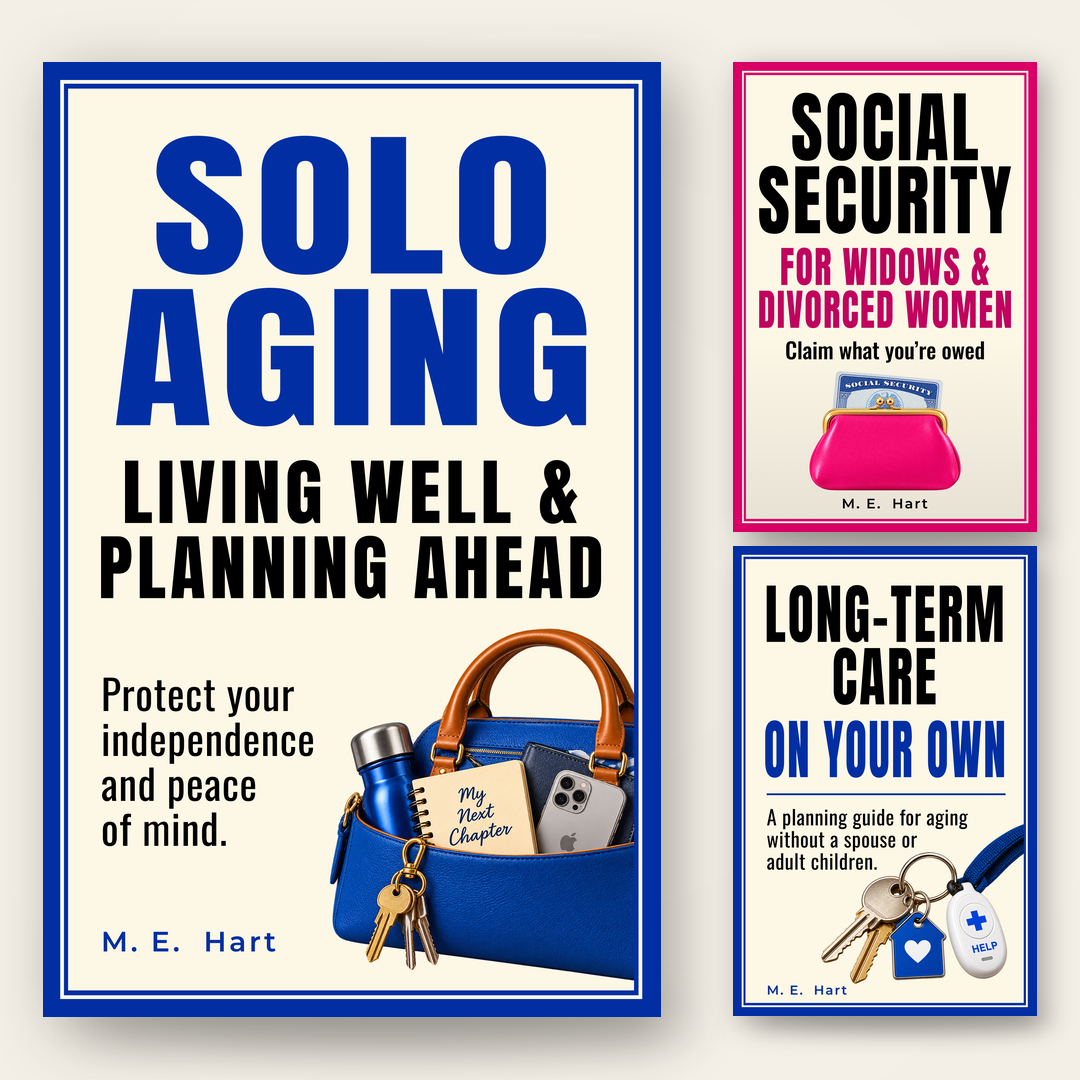
Social Security for Widows & Divorced Women
Solo Aging
Long-Term Care on Your Own
578 printed pages
Free US shipping
Exclusive Living Alone Safety Toolkit
$80.97 separately ·Save 13% ·Free US shipping
What readers say
4.756
Pooled across all three books in the bundle. 56 ratings, 54 with a written review. Every written review is below — nothing is filtered out.
“You Will Not Find all of this info easily on the Social Security website.”
Social Security for Widows and Divorced Women by M. E. Hart is basically a guide for widowed or divorced women to plan for the most in social security benefits. Though it says women, widowers would benefit to know this information. It is hard to get information from social security because they are often only partially knowledgeable themselves. They make mistakes in math and do not realize there is any other way to receive benefits. Even though we try to understand government guidelines it is hard when you are mourning. I suggest purchasing this book if you are thinking divorce or have warning about pending death of a spouse. Then you can peruse the rules put forth and have a plan that will benefit you financially. The book is set up so that you can skip parts that do not pertain to you and for quick reference. Do you take your own benefits? Or Do you take a spouses benefit or a former spouses' benefits? When are you eligible? Which one is the best for your situation and can you change your mind later and receive a larger benefit. These questions are all answered and timely as of 2026 and will be available when you need them.
M., verified reader · Aug 2026
“A Guide for the Solo Ager”
That opening scene the Tuesday morning aide who never shows, leaving the woman in the apartment unaware of the two hours of frantic phone calls happening behind the scenes to fix her week hit me like a gut punch. This book finally names the invisible second job of long-term care, the one that nobody pictures when they imagine needing help. The author walks you through every terrifying blank on that Care Management Map at the back with such patient, unflinching clarity that I felt less alone just reading it. M.E. Hart doesn't sell false comfort, she hands you a flashlight and a map, then sits beside you while you figure out which caverns are yours to cross alone.
Chantal, verified reader · Sep 2026
“If you are planning to age alone or you know someone who is take a look at this book.”
I really enjoyed this book. I think anyone older and looking to age solo can get something from this book. I feel there were many ideas and guidance in this book. I love how the author points out some of us were just caregivers for loved ones and have been down this road but we were taking care of other people now its about us and we need to make a plan read this book if you want some good guidance in this direction.
Tanya, verified reader · Aug 2026
Read all 54 reviewsHide reviews
“Planning for the Days We Cannot Predict”
Life is fragile, and it can change in the blink of an eye. You can wake up on an ordinary Friday morning with nothing out of the ordinary, never imagining that you may not see the next day—or that your health could suddenly change and lead to doctor’s appointments, hospital visits, and decisions you never expected to face. I believe deeply in the providence of God. I didn’t know when I was coming into this world, and I don’t know when I will leave it. But trusting God doesn’t mean I shouldn’t prepare for the years ahead. That is what drew me to Retirement in Order: Long-Term Care on Your Own. This book provides a sense of structure and a practical framework for thinking about something many of us would rather avoid: How will I care for myself if I grow older without a spouse or adult children to rely on? As someone without children, I found this perspective especially meaningful. Retirement planning is often presented around the traditional family structure, but not everyone will have a spouse, children, or relatives available to step in when they need assistance. That doesn’t mean we should approach the future with fear; it means we can approach it with intention. This book encourages readers to think ahead about long-term care, support systems, finances, housing, decision-making, and the practical realities of aging independently. For me, the biggest takeaway is that planning for my latter days isn’t a lack of faith—it can actually be an act of stewardship. I may not know what tomorrow holds, but I can make thoughtful decisions today that give my future self more options, dignity, and peace. If you are aging without a spouse or adult children, or simply want to be more intentional about your later years, this is a guide worth picking up. We cannot control how life unfolds, but we can prepare for the possibilities while trusting God with the outcome.
Youde, verified reader · Oct 2026
“A Masterclass in Systems Architecture for Solo Aging”
Most retirement guides tend to treat aging like a sentimental postcard or a sudden medical emergency, completely ignoring the administrative engine required to hold a life together, but this book cuts through all of that noise with refreshing clarity. When most people think of needing help, they picture an aide assisting with a transfer or fixing a meal, but they completely miss the invisible "second-job" that is the hours spent on the phone disputing billing codes, managing fractured agency schedules, handling pharmacy mishaps, and reconciling doctors who never talk to each other. For those aging without an automatic co-pilot like a spouse or nearby adult children, an unmanaged system will fail at the seams. Hart treats this as a systems-and-logistics problem requiring clear operational boundaries, and not as an emotional tragedy. The book forces you to look at your actual blind spots and systematically assign owners, backups, or honest question marks to every critical life function. If you value self-reliance, systems thinking, and actionable architecture over hand-wringing platitudes, read this book; build the map, ask the uncomfortable questions early, and get your operational framework on paper while you're still standing on your own two feet.
Anthony, verified reader · Oct 2026
“Very good resource 👍”
Author's key reminder, "nobody is coming for me so I made a plan", reminds me of a former supervisor I had. She also stressed the importance of self-responsibility.
If you are also facing the fact that you don't have the family that culture automatically assumes will step up for you, then it would be of great benefit to you to work through this book. As you do, you'll discover you're not alone. There's somewhere around 15 million others in the same situation. And that number is only expected to grow.
You'll also discover relief and a sense of peace. While it may dredge up some unpleasant emotions, don't stay there. Press forward and do the work. You'll be glad you did. I am.
Even if you do have family, you can still use this book. It gives you a clearly outlined plan and documents that need to be implemented sooner rather than later. That said, it's written specifically for those of us that don't (have family to step up).
I found the kit provided at the end of the book (ch 12/appendix) to be very helpful.
I encourage you, however, to start at the front of the book as the author gives important details you'll need. It's a short read. Well worth the time. Very good resource. 👍
Sky, verified reader · Oct 2026
“Great tool for those needing to make a will!”
This is a wonderful book for those that need to plan their will, but do not have dependents or a spouse.
It is difficult to plan who to have serve as your power of attorney if you do not have immediate family.
This book goes into detail about everything from who will make your medical decisions if you can't to affording housing and your care as you age. Most people have their spouse, dependents or family as their POA, but what if you are not married or widowed? And have no children or living family members? This is something that a person must think about when they are alone and need someone to trust that can provide these services.
As someone with no children, I did not think much of my care since I am married. But if I am a surviving spouse in old age I need to have a care network of those that can help as I age. This book has been a tremendous help and made me think of things that could become issues in the future. I highly recommend this book for anyone of any age planning their will, elder care, etc. It gives you topics and issues to consider that may not be on your radar right now.
Heather, verified reader · Jul 2026
“Vital info”
This book was a great, quick read, but one that holds vital information for women navigating the social security landscape as a surviving spouse (widow) or as a divorcee. One thing I wish, though, as it would've made for easier navigation between chapters that didn't apply to the widow (versus divorce, as these parts were intentionally separated by the penning author) is that the Table of Contents showed corresponding page numbers for each chapter. There are some genuinely vital details that every woman in these categories should know, from deciding when to file to maximize the benefits (their own + their late husband's), to setting up your SSA.gov account in advance online to track your own earnings, and to double checking SSA's calculations. In an audit, a huge percentage of widows weren't paid survivor benefits in the amount they were owed! The author also shares hypothetical scenarios as an example in each part—for widow and divorcee alike. It's a short book, but again, one packed full of vital information.
Alexa, verified reader · Jul 2026
“Feel Better About Solo Aging!!”
Solo Aging is straightforward and a little scary as it encourages people to come to the realization that they don't have "a default person" who can help when they need an emergency contact, someone to take them home after an emergency procedure, know where the important papers are, someone to help with medications....and on and on. I read this book because this has been weighing on my mind a lot, and it helped erase some fears and negative thoughts that started a year or so ago. For one thing, Solo Aging is "A category, not a character flaw." This book will help you change your views from negative to more positive about solo aging. Each chapter helps you choose the person or persons who can help you later in life. I loved the idea to include one or two people to watch for signs of physical and especially cognitive decline. This is a valuable book!
Jenni, verified reader · Oct 2026
“Having a plan is very important!”
The disclaimer up front is very important because rules and laws are so different in each state and also seem to change frequently. I feel like things are more complicated in retirement… I thought things would be made easier for us seniors, but nope. The ‘2 a.m. self-talk’ as described in the book hits the nail on the head. The goal reinforced here is to have a plan. Being alone is OK, but have plans in place. Solo-ager is a new reference term for me. I have to admit, I have learned a lot because I’ve had to step in for an aunt who never had children and is now over 100 years old. I have learned a LOT dealing with her, and the fact that I have no children and am a widow. This book is great. I like the pace and its honest but gentle and practical advice. As a bonus, there’s a document kit at the end of the book. Nice!
Some, verified reader · Oct 2026
“Planning for Care When You're on Your Own”
What I find most useful about this guide is that it looks beyond receiving care and explains who will actually manage everything behind the scenes. Finding reliable help, handling schedules, checking services, and arranging backup are easy things to overlook until they become urgent. The nine planning tools also sound practical, especially the first-call list and care management map. I appreciate that the book acknowledges local differences instead of pretending one plan works for everyone. It feels thoughtful and realistic for anyone preparing to age independently.
Tracy, verified reader · Oct 2026
“Good Book”
It's a sad thing to be alone. I watched this with my sister. She would just sit in her room and wait to pass on. I wish I had this guide to give to her. But now I find that I'm in the same situation with my older brother who lost his wife and seem stuck. So I got this for him to hopefully help him make a turnaround and make some plans as he gets older. So we'll know what to do or what he wants to do. This is one of those books you should have in your library whether you are alone or not. We all know someone that's aging and along and maybe this will help them.
Cheryl, verified reader · Oct 2026
“A Practical Plan for Aging Independently”
What I appreciate about this guide is that it covers the work behind arranging long-term care, not just the care itself. Finding reliable help, managing schedules, checking services, and having a backup plan are important details that people can easily overlook. The planning worksheets sound especially useful, particularly the care management map and first-call list. I also like that the book acknowledges that local services differ and encourages readers to find out what applies to them. It feels realistic and thoughtfully organized for solo agers.
Trent, verified reader · Oct 2026
“Good Resource for Planning for our Elder Years”
Good Informational book to help those who are wanting to be well informed about the aging years ahead of us. This book is geared to someone who is a “solo” heading into the aged years, but there are many things that elder couples can use also.
Many important issues are covered. Important documents to have in order, medical care, support system. Making decisions and having backups installed and ready for when they are needed. This lets you age independently, feeling prepared for your future.
Deb, verified reader · Sep 2026
“Great Resource”
This book was really helpful and it explain everything in a way thats easy to understand. I learned a lot of things I didnt know about Social Security benefits for widows and divorced women. The information was clear, easy to follow, and could save people a lot of money if they know what to look for. I definately recommend this book to anyone going through this situation because it answers a lot of important questions and makes a confusing process much easier to understand.
Devon, verified reader · Jul 2026
“An eye-opening book with a lot of greeting information”
This was a great resource. It had a lot of interesting points and gave a lot of information for someone who is going through the aging process alone. Talks about where to start information that you need paperwork, figuring out how to choose that someone that can make decisions in case you can’t make them yourself. And how to choose the right person for that. As someone who doesn’t have family or a spouse is definitely something that I need to start looking into.
Rosemarie, verified reader · Aug 2026
“A Practical Approach to Aging Independently”
I appreciated how this guide focuses on the practical tasks that can be easy to postpone: choosing decision-makers, arranging backups, organizing documents, and thinking through housing and care. The concrete action at the end of each chapter sounds like a helpful way to turn planning into manageable steps. It treats solo aging with respect and recognizes that building a support network can mean assigning different roles to different people.
Ana-alicia, verified reader · Oct 2026
“Long term care on your own”
This book is a great addition to your elderly care plan. It will help you along with planning for your self care as you age. It also gives pointers on what Medicare covers and the basics and how to for daily care from hospital, being at home alone and employing outside help if you don't have a family member close by or present. It's great information that can assist you in making an informed decision on you long term care.
Hidy, verified reader · Aug 2026
“Great Guide”
This is a great guide for people who are preparing to age independently without assuming family will always be available. The advice is clear, realistic, and gives useful steps for organizing healthcare, finance, housing, important documents before they are needed. Some of the information are easy to overlook, but the concrete actions at the end of each chapter makes the planning feel much more useful..
Devon, verified reader · Sep 2026
“Awesome!”
The thought process of this guide is absolutely amazing. I don’t think I really ever thought so in depth about living ahead. I think as humans we’re so into living in the now more so. This book is so real and very in depth how it is written. I can also see the author is speaking from their perspective and that very refreshing to read about. This is such a great and very informative piece!
Charise, verified reader · Sep 2026
“SSA help for Widows & Divorced Women”
This book offers clear explanations and examples to help the reader find the right social security benefit for them. There is a lot of information that needs to be addressed and some may or may not apply to the reader. This book is a roadmap. The examples are easy to follow. The book includes worksheets in the Appendix which will be extremely helpful.
Reina, verified reader · Jul 2026
“Practical Guidance for Solo Aging”
Solo Aging: Living Well & Planning Ahead is written in a straightforward, clear way. It contains a plethora of useful information (for both solo agers as well as those with partners)! Especially useful is the Appendix that includes a Document Kit with actionable steps to complete in order to feel prepared to "exit on your own terms."
Wendy, verified reader · Oct 2026
“The big one”
A step by step guide into preparing for the 'big one'. It makes planning simpler when you don't have a large support system, but I will say it can help anyone close to that age. How can you ask for support, be supportive and most of keep yourself calm and prepared for something so daunting.
Timeslikethis, verified reader · Oct 2026
“An Important Topic Worth Thinking About”
I appreciate the focus on independence and planning for the future. Aging is something many people don't prepare for early enough, and this book addresses a subject that deserves more attention. The emphasis on being proactive and making thoughtful decisions is especially valuable.
Dicle, verified reader · Oct 2026
“Social Security”
Tells elders and people who are getting older how to deal with social security and possibly debt after dealing with a lost one, if you or a loved ones social security is not up to date or fine with no issues then you shouldn't leave any problems for your family
Arii, verified reader · Jul 2026
“Comprehensive Read”
Aging is A great thing but it come with challenges of taking care of yourself as well this book gives you the tools to do just that make sure you are planning properly and taking care of literally all your needs from health to estate planning
Hmh, verified reader · Oct 2026
“Super helpful!”
This breaks down everything you need to know! It covers things like which benefits you should look into, what order to claim them in, and when; which is super important when trying to save money. Worth the read!
Whitney, verified reader · Jul 2026
“Solo Aging”
This book offers some practical tips and some excellent information if you are interested in learning more about retiring successfully.
I received a free copy of this book and am voluntarily leaving a review.
Verified reader · Aug 2026
“easy to understand”
informative and well written in easy to understand language. I benifited fro quite a bit of the information that was provided > I liked the way the ideas were broken down into easy to understand sections.
Karen, verified reader · Oct 2026
“Very good guide”
I'm someone who is hyper independent so I really like this book to help with figuring this out for when I do get older. I have a plan and an idea. This was really helpful to do that
Krystal, verified reader · Oct 2026
“Very helpful for planning”
Very helpful and brought to my attention categories of needs I would not have thought about on my own. It is a good type of book to go back and reference as needed as well.
Tori, verified reader · Oct 2026
“Solo”
This was a good book to read to prepare on being alone when older and how to plan for it..you never know what will happen in life and its good to be prepared!
Fortune, verified reader · Oct 2026
“Useful Tips”
Not necessarily only for solo aging but could be useful to anyone thinking for self. Ideas outlined here are easy to consider using.
Beachwriter, verified reader · Oct 2026
“Guide for financial and medical preparedness for elders who are alone”
All in one guide for those who grow older alone but need a plan to secure themselves financially and medically
Karen, verified reader · Oct 2026
“Book For Those Planning On Retiring Now Or In The Future”
A Very Interesting Book to Read for Those who want to plan or are planning to retire. A++
Robyn, verified reader · Aug 2026
“planning ahead”
great read for people who love to plan ahead for the future! definitely a must read
Christi, verified reader · Sep 2026
“Its life”
Extremely helpful and beneficial if you are having to experience Long Term Care.
Heather, verified reader · Oct 2026
“Important Information”
This book has a lot of great information for those of without children.
Bridgett, verified reader · Oct 2026
“Wow”
This book is usually not my cup of tea but it was really good!
Your, verified reader · Oct 2026
“Practical”
Solo Aging addresses an important part of getting older that many planning guides overlook: what happens when there isn’t one obvious person you can depend on. I appreciated how practical the approach is, covering questions about medical care, decision-making, important documents, housing, and building a reliable support system. Rather than focusing only on finances, it considers the everyday situations where another person may eventually need to step in. The emphasis on creating backups and making decisions before they’re urgently needed is especially useful. A thoughtful and practical resource for anyone planning to age independently and wanting to feel better prepared for the future.
Shannon, verified reader · Sep 2026
“Long term self care”
This book covers an important topic for people who may need to plan for their future without a spouse or adult children to depend on. It focuses on preparing for long-term care, making important decisions, and finding resources to maintain independence as people age. I like that the subject encourages readers to think ahead instead of waiting until they need help. However, planning for the future can feel overwhelming, so having practical steps and clear explanations is important. Overall, this book could be a helpful resource for individuals who want to feel more prepared and confident about aging independently.
Jayden, verified reader · Oct 2026
“Planning Beyond the Care Itself”
I appreciated how this book looks at long-term care from a practical angle that is easy to overlook: who actually manages everything when help is needed. The distinction between receiving care and coordinating care stood out to me. I also liked the planning tools, especially the first-call list, hiring questions, and care management map. Rather than making assumptions about where readers live or what resources they have, the book encourages them to identify what applies locally. The focus on backup plans and eventually handing over responsibilities makes the subject feel more manageable and concrete.
Nathan, verified reader · Sep 2026
“Creating a strong plan and network for your old age.”
Very practical book when it comes to solo living as an old aged person after retierment, it has all the condition written detailed.Someone who once cared for their parents or relatives and now they are at the stage when they need to think about getting care- this book is a helpful for reflecting on those days. Also, I loved the chapter 3 most considering the condition of a person living solo in USA.Mostly we lacked the support network as an old person and whoever wants to feel well prepared in their old age with all the physical and mental diclines needs to read this book.
Samou, verified reader · Oct 2026
“Solo Aging: Living Well & Plaaning Ahead!”
This book is great for those who are without kids, or spouses and they're getting older. You're getting older by yourself and need to learn how to find a person who can be your emergency contact, assist you with going to your Doctor appointments, learn what you want for your final wishes. It also explains how to be your own health advocate. It teaches you to plan ahead.
Lisa, verified reader · Aug 2026
“A necessary book”
“Picture yourself needing care someday.” This is a practical, professional, and very detailed book. It brims with data, probably many of us have never thought of needing. So yes, it is a good, a helpful, and a necessary book. The only setback (maybe just for me), is the somewhat cool delivery. Nevertheless, this is a great source of relevant information to keep handy.
Carna, verified reader · Oct 2026
“Planning for your parents”
Long Term Care On Your Own is a practical and reassuring guide for people planning for aging without a spouse or adult children to rely on. The straightforward advice on preparing for future care needs, organizing important decisions, and maintaining independence makes it a helpful resource for anyone navigating solo aging.
Amber, verified reader · Oct 2026
“Social security information.”
The information is very informative and gives us the knowledge of what social security can provide. I noticed that some information is not up to date. It could be that from the time the book was written things have changed. Still a good book to read.
Nora, verified reader · Jul 2026
“Recommend”
It's straightforward, realistic, and sometimes a little uncomfortable which is why I found it useful. It made me realize that the best time to figure out who will manage my care is while I'm still capable of making the decisions myself.
Kayla, verified reader · Aug 2026
“The nexts step”
I found this book repeated some of the same information. However for the most part it contains great information for some who has no family to help with age and the steps they need to take
Kathy, verified reader · Jul 2026
“Long term care on your own”
This guide helps you to cope with aging when you are on your own. It helps you to plan for what it could be like when you are elderly and alone.
Tanya, verified reader · Oct 2026
“Insightful”
Very insightful. Brought this book for an elderly friend of mine and they really appreciate the tips on navigating as they get older.
Verified reader · Oct 2026
“Long Term Care On Your Own”
It's a very straightforward book, it talks about all of the necessary topics that should be discussed as you get older.
Riley, verified reader · Aug 2026
“Informative, but Nothing That Really Stood Out”
This book was okay, but I wouldn’t say it was anything exceptional. The concept is definitely useful, especially for people who are planning for their future without a spouse or adult children to rely on. It touches on an important topic that doesn’t always get enough attention. However, I was hoping for something a little more detailed and engaging. While there is some helpful information, I didn’t feel like it offered anything particularly groundbreaking. It’s a decent starting point for someone beginning to think about long-term care planning, but I wouldn’t rely on it as my only resource. Overall, not a bad book, just not one that really impressed me.
Jazmyn, verified reader · Oct 2026
“Good read”
this book was alright just not exactly what i thought it would be
Rhonda, verified reader · Oct 2026
Where the numbers come from
Named sources, not a forum thread.
What Medicare covers, who qualifies for help with care, and who can claim on whose Social Security record are all set by somebody. These books name that somebody on the page where the rule is used, with who to ask.
MedicareLimited skilled care, not ongoing custodial care
MedicaidWho qualifies for help with long-term care
Social SecurityWho qualifies on whose record, and at what age
SSA Inspector GeneralAudits of how widows are paid and informed
Good to know
Common questions
What's actually in the bundle?
All three paperbacks, shipped together in one parcel: Social Security for Widows & Divorced Women (134 pages), Solo Aging (150 pages) and Long-Term Care on Your Own (294 pages), all 5.5x8.5. They are the same editions sold separately — nothing is abridged.
Which one should I read first?
The Social Security book, and not because it is first on the cover. What you claim, and when, sets the income the rest of the plan is built on — including what you will be able to afford when care is the bill. Solo Aging comes next, because naming a healthcare agent takes an afternoon and cannot be done retroactively. Long-Term Care on Your Own is the research, and it is the one to read while nothing is urgent.
I'm divorced, not widowed. Is half of the first book wasted?
No — it splits at that fork and works each side to the end, so you read your half and skip the other. The divorced-spouse side is the one more people get wrong: the 10-year line, the 2-year rule, and the belief that claiming on an ex's record cuts his check or touches his current wife's. It does neither.
How is this different from the two-book Solo Series?
That one is two of these three — Solo Aging and Long-Term Care on Your Own — with no Social Security book, because someone who never married has no survivor or ex-spouse benefit coming. This one adds the book about the money a marriage leaves behind, which only applies if you were married. If you were never married, or were married under ten years and not widowed, buy the pair instead and keep the difference.
Does Medicare cover the long-term care part of this?
Less than most people expect, and we'd rather say so up front. Medicare may cover limited skilled care when specific requirements are met. It generally does not pay for ongoing custodial care, the day-to-day help with bathing, dressing and meals that most long-term care actually is, and Medicare says so on its own long-term care page. That gap is what the third book is written about — what the help costs, which public programs cover part of it, and how to pay for the rest.
Is there a free guide that goes with these?
Yes, and it's free. A flowchart on our site asks a few questions and shows which Social Security benefit to claim first — widow, divorced-spouse, or your own. It doesn't require the books.
My divorce isn't final yet. Should I wait?
No. The ten-year line is measured to the date the divorce is final, so if you are anywhere near that mark the timing of the decree is itself a decision worth several years of benefits — and it is a decision you can only make before it is signed. That chapter is the reason to read this now rather than after.
How fast does it arrive?
All three books are printed to order and posted together in one parcel. Free US shipping, and delivery runs about two weeks. There is no rush tier, because the printer sets that schedule and not us — we would rather give you the real date than sell you a faster one we don't control.
Can I give one away and keep the others?
Yes. They are three separate books in one parcel, not a boxed set — and the Social Security one gets handed on more than anything else we publish, usually to a friend who assumed she was not entitled to anything.
I already called Social Security. Didn't they tell me my options?
They told you what you can claim today, which is what they are there to do. What nobody at the office is required to work out for you is the order — whether to take one benefit now and let another grow, and what switching later would be worth. That is what the Social Security book walks through, on your own figures.
Does claiming on my ex-husband's record take money from him or his wife?
No. Social Security does not ask his permission, and does not reduce his benefit or his current wife's by a cent — SSA's own filing rules say so. What you receive comes out of the system, not out of his check. It is the most common reason women who qualify never file, which is why the book answers it early and in full.
It's been years since the divorce. Is it too late for any of this to matter?
Almost certainly not. A divorced-spouse claim turns on how long the marriage lasted, whether you are unmarried now, and your age — not on how long ago the decree was signed. The only place the divorce date counts is the other way round: if he hasn't claimed yet, you generally need to have been divorced at least two years. Women file on marriages that ended decades earlier. If your ex has since died, a different set of survivor rules applies, and the book has a chapter on that.
I remarried. Is any of this still mine?
It depends on which benefit and on your age when you remarried, and the two rulebooks are not the same — which is why people get it backwards. A survivor benefit is generally protected if you remarried at or after 60. A claim on a living ex-husband's record generally needs you unmarried now, and that door can reopen if the later marriage has itself ended. The book works both sides through with the ages attached.
How long does this actually take?
The Social Security decision is an afternoon with your statement and five worksheets — and it is the one to do first, because everything else is paid out of what it settles. The paperwork naming who may act for you is a second afternoon. The long-term care book is the reading you do while nothing is urgent, which is the only time anybody reads it well.
What if it isn't right for me?
Each book is printed for you one copy at a time. If your parcel turns up damaged or misprinted, send a photo within 30 days and we ship a replacement free — you keep the flawed copy. Because every copy is made to order, we can't take a book back once it has shipped. Contact details are at the bottom of this page.
Your next chapter, organized
You will make these three decisions either way. Make them with the rules in front of you.
The benefits you are owed, the person who signs if you can't, and the care somebody has to arrange. Start with the money — the rest is priced off it.