Paperback
He handled the money. Learn what you own before you're asked to decide.
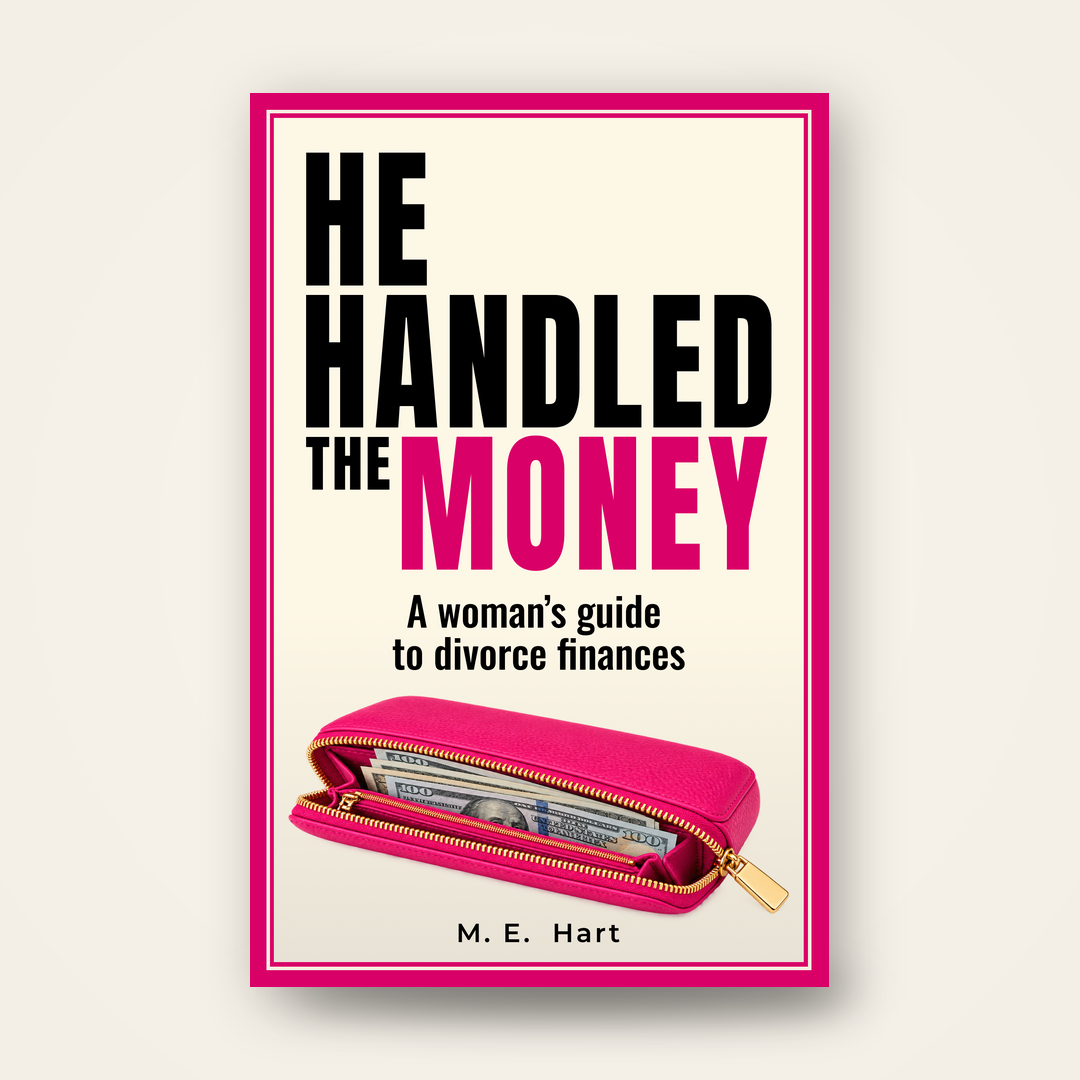
Divorce, or the thought of it, can leave you deciding about money you never managed or were never fully included in. This book helps you understand what matters, what to look for and what to ask, so you go into any decision informed, not guessing.
He Handled the Money: A Woman's Guide to Divorce Finances
- ✓Understand what you own, owe and need to verify
- ✓Make sense of the house, retirement, support, taxes, insurance and Social Security
- ✓Know which financial questions to ask before agreeing to anything
- ✓Find free or lower-cost help when professional advice isn't financially realistic
One paperback. Free US shipping.
It'll cover questions that you never thought of
Before everything explodes, get your information together
This book is the one you need if a divorce is inevitable.

Written by
M. E. Hart
Retired product and customer experience leader with a career in healthcare and insurance.
She spent years translating complicated systems, paperwork and decisions into consumer experiences people could actually use. Retirement In Order applies that same approach to aging, retirement and getting important affairs organized.
Try this first
Five questions somebody will ask you about the money.
If he handled the money, you can probably answer one or two of these today. None of them is a test of whether you were paying attention — it's a list of what has to be known, and right now one person knows it.
- What do you own, and does whose name is on it settle that?
- What do the two of you owe, and what does your credit file say now?
- Can you keep the house, and who actually decides that?
- What kind of retirement plan is it, and what will the plan act on?
- Which of the two kinds of support could be on the table?
You don't have to answer any of these tonight. You have to know which desk each one belongs on — because most of them aren't your attorney's.
Who actually answers it
| The question | Whose desk it is |
|---|---|
| Is the house marital property? | State law, through your attorney |
| Can we split the 401(k) the way we agreed? | The plan document, through its administrator |
| Can I keep the house? | The lender, on your income alone |
| Can I claim on his Social Security record? | SSA — federal rules no decree changes |
| Is the support taxed? | The IRS, by which kind it is and when it was signed |
The book explains what each question is asking and who has the authority to answer it. It won't tell you what your settlement should be — nobody who hasn't read your file can.
The question you can't answer yet
Nobody hands you the file on the way out
Somewhere in the marriage, the financial side became one person's department. It worked. Then it stopped working, and the first thing anyone asks is the thing you can't answer: what do we own, what do we owe, and where does the money actually come from.
This book starts there. It isn't a pep talk and it isn't a legal brief. It is a plain-English account of how the money side of a divorce is put together: what the words mean, which questions belong to a lawyer and which belong to a plan, an insurer, a lender or the Social Security Administration, and what to do when the answer is somebody else's to give.
From the author
Watch: do you know what you actually own?
He handled the bills, the accounts, the insurance, the taxes. Now you're the one being asked what you own — and you don't have to become a financial expert overnight to answer it.
- ✓ What exists, what to ask, and what to handle first
- ✓ Who is actually allowed to answer each question
- ✓ Captioned · 34 sec · watch right here
Peek inside
See the actual pages
Not descriptions of the pages — the pages. Swipe through, and tap any one to read it full size.
What changes when they arrive
This is what you can say out loud by the time you put it down — in your own words, from your own list. One paperback, 244 pages, free US shipping.
Say what you own, what you owe, and what you still have to find
The accounts, the debts, the income and the property worked through one at a time, with the blanks marked — because a column of “I don't know” is what you bring to a professional, not a failure.
- Why whose name is on it doesn't settle who owns it.
- What your credit file says about you now, and what the household costs to run.
Two fill-in checklists — no account numbers, no balances, no passwords
Walk into the house, the retirement money and the business knowing who really decides
Title and the loan are the lender's call, a retirement account follows its plan document whatever the two of you agree, and a business has books somebody outside it needs to have seen.
- The four questions inside “I want to keep the house”.
- Why a retirement plan follows its own rules rather than your agreement.
One chapter each — the three that are never simple
Send every question to the desk that owns it
Federal law frames the retirement plans and Social Security, state law divides the property, and the plan, the policy and the mortgage note decide what an administrator will act on — each question routed before you pay anybody to sort them for you.
- Which questions belong to your attorney, and which to a CPA, a lender or SSA.
- Help that exists when money is tight, and how to direct the rest of the team.
A one-page map of who answers what
Start tonight
You don't have to build the picture tonight. You can find its edges.
Three things on one sheet of paper, from what you already know. None of them needs the book open — or a login.
What you already know exists
List every account you already know about, by name — the bank, the cards, the mortgage, the retirement plan, the one through his work. Names only. Balances come later.
Where the blanks are
Next to each, mark what you'd have to look up: whose name is on it, who holds it, what kind of account it is. The marks are the list.
What you need answered first
Write the one question you want answered before you agree to anything. Say it in a sentence. It's the first thing you take to whoever can answer it.
Twenty minutes, and “I don't know” has become a list — the one thing every professional you meet can actually work with.
Know what you're looking at before anything is decided.
One paperback. Free US shipping.
What readers say
Every review we have is below — nothing is filtered out.
“Must Read!”
If you're going through a divorce and you don't know where to start, this is the book for you. It'll cover questions that you never thought of, I didn't anyway. It goes in-depth about how things work and what you should consider. I highly recommend reading this
Whitney, verified reader · Aug 2026
“He Handled The Money”
This book is geared toward women in long term marriages where there is retirement income, businesses, and or property involved, and the marriage is or may soon be on shaky ground. Before everything explodes, get your information together ladies. Have knowledge of what income and or property is considered marital and what property is not. These things are particularly important when the situation has been the husband has been the main earner and the wife if not knowledgeable about the marital finances. The book is a guide to what you need to know before hand and just in general in case things don't go as planned. Forewarned is to be forearmed and ready for anything. This guidance is for a specific marital situation and you will know right away if you need this information.
Dedra, verified reader · Aug 2026
“Ask the right questions!”
Suddenly realizing your financial picture with someone you trusted is something you were shielded from or unaware of, as they were controlling the money, is exhausting. We're expected to know where it all stands while feeling overwhelmed and stressed. It makes moving forward especially difficult. The author explains steps for putting the pieces back together. She explains how to figure out what questions to be asking, what should be verified, and when to turn to an attorney, accountant, or other financial professional. For me, the biggest takeaway was about having a voice in decisions that affect our futures. If you're a woman facing this position, or want to be educated before ever reaching this position, this is a book I genuinely recommend.
Hello, verified reader · Sep 2026
Read all 10 reviewsHide reviews
“Finance for the other spouse”
This book is the one you need if a divorce is inevitable. It offers every detail of what will occur. I think it is valuable even if you're not going through a divorce. Each partner should understand their financial pictures. It provides definition of all aspects of finance. The explanations are easy to understand. Great book.
Nancy, verified reader · Aug 2026
“A must read, especially for females”
He handled the money, is a very practical and educational book. That allow readers to better understand how assets are settled in a divorce. This is a must read due to the amount of divorce taking place in recent times. Understanding the pitfalls, the laws that overrides emotions and revenge.
Marvalyn, verified reader · Aug 2026
“Handled the money”
This is a good book to read if you are facing a divorce. I wish I would of had this book for the advice it gives. The advice I read was solid and useful.
Charity, verified reader · Aug 2026
“Take control of your finances!”
Insightful, practical, and even sensitive. I've known too many women who divorced and were lost because the husband had all financial paperwork in his possession. I appreciate how the author even warns the reader to be careful with this very book if it is unsafe for her to read - very unique touch. In the end this is a guide, not a substitute for legal advice, but it's a helpful tool for women who find themselves in this unexpected situation.
Norma, verified reader · Aug 2026
“Very Informative”
A guide for women whose husbands handled the finances in the relationship. Different situations are covered under three categories: federal systems and laws, state law and the personal facts of your case and what the plan, policy or institution decides. Includes checklists, charts and resources.
Ileana, verified reader · Aug 2026
“This books reminds you to know your financial status!”
This book is a good reminder to always know your financial affairs. Never, ever let your partner “handle” all financial responsibilities. It needs to be a joint effort to protect all involved.
Diane, verified reader · Aug 2026
“It explains everything so you can actually have an idea of what to do and ask”
Direct explanations of how divorce finances work. Helps you figure out what you own, what you owe, and how to stay on top of meetings with accountants and advisors without feeling lost
Kitten, verified reader · Aug 2026
Where the answers come from
Three rulebooks, and the desk each one belongs to.
Federal law frames the retirement plans and Social Security. State law decides how property is characterized and divided, which is why no book can tell you how your case comes out. The plan document, the policy and the mortgage note decide what an administrator will act on. This book names which one is speaking on every page, and who to take the question to.
- IRSHow support and a transfer between spouses are taxed
- Social SecurityWhether you can claim on an ex-spouse's record
- State property-division lawHow property is characterized and divided
- The plan, the policy, the noteWhat an administrator, an insurer or a lender will actually act on
Good to know
Common questions
What does this book actually cover?
Twenty-three chapters on how the money side of a divorce is put together: what marital property, separate property and commingling are asking; what you own and what you owe; where the income comes from and what a household costs; the house, the retirement accounts and a family business; support, taxes, health coverage and the ex-spouse Social Security rules; how to choose and direct a lawyer; and what the decree starts rather than finishes. It ends with two checklists and a one-page map of who answers what.
Is this legal or financial advice?
No. Divorce law is state law, your facts are your own, and no book has seen them. This is educational information written to tell you what you are looking at and who has the authority to answer it — not what to do about your case. Take the specifics to a lawyer, a CPA, your plan administrator or your insurer, and confirm current rules at the source.
Is it still useful if I already have a lawyer?
That is usually who it is written for. A lawyer answers legal questions about your case, and a great many of the questions that keep a person awake belong instead to a plan administrator, a lender, an insurer or the Social Security Administration — nobody in the case has a reason to raise those with you. The book is about following what is being said in the room and knowing which desk each question goes to.
I'm not a numbers person. Is this going to be over my head?
There is no math in it and no assumption that you know the vocabulary. It names a term, explains what the term is actually asking, and moves on. The two checklists at the back ask for no account numbers, no balances and no passwords — only whether you understand a thing, know it exists, or don't know yet. A column of “I don't know” is not a failure; it is what you bring to a professional.
Does it help if I'm not the one who filed?
Yes. Nothing in it depends on who started it or how far along the case is. Chapter 1 is about the moment you realize you need to know, and that moment arrives at very different points for different people — before anyone files, in the middle of a case, and sometimes a year after the decree.
There is an unsafe situation in my marriage. Is that in the book?
Chapter 17 closes with a section on it, written so it can be found and read on its own without reading anything around it. It names the specialized help that exists: domestic violence legal advocacy programs, and organizations that work specifically on economic abuse. If you are in danger right now, that is a call to make before a book.
Is this the right book for me?
It's for you if your husband was the one who knew the money and you'll be the one asked about it: by a lawyer, a lender or a form, now or if the marriage ends. It won't tell you what your settlement should be, because nobody who hasn't read your file can, and it doesn't replace your attorney. If you already ran the household finances and just want an overview of divorce law, these 244 pages are aimed somewhere else.
What if it isn't right for me?
Each book is printed for you one copy at a time. If your parcel turns up damaged or misprinted, send a photo within 30 days and we ship a replacement free — you keep the flawed copy. Because every copy is made to order, we can't take a book back once it has shipped. Contact details are at the bottom of this page.
Your next step
Know what you're looking at before anything is decided.
What you own, what you owe, and who decides each of the three that are never simple.
The words explained, the questions routed to whoever can answer them, and a list in your own handwriting of what you know and what you still have to find. One paperback, posted to you.
What the money buys against isn't a book. It's paying by the hour to learn what the words mean.
One paperback. Free US shipping.
You may also be interested in


Start getting retirement in order — one simple checklist at a time
Free quick-start checklists to help you organize the practical parts of retirement: what to gather, what to decide, and what to write down first.
- What to gather
- What to update
- What to share with family
Almost there — check your inbox.
We just sent a confirmation email. Click the link inside and your free download lands right after. (If you don't see it, check spam or promotions.)
 He Handled the Money$27.99Paperback
$27.99Paperback
