Paperback
Something in the money doesn't add up. Saying so isn't an accusation.
You noticed something in the money, and you can't tell whether it means anything. You don't have to know whether he's hiding money — you have to know what you actually saw. A gap isn't a dead end.
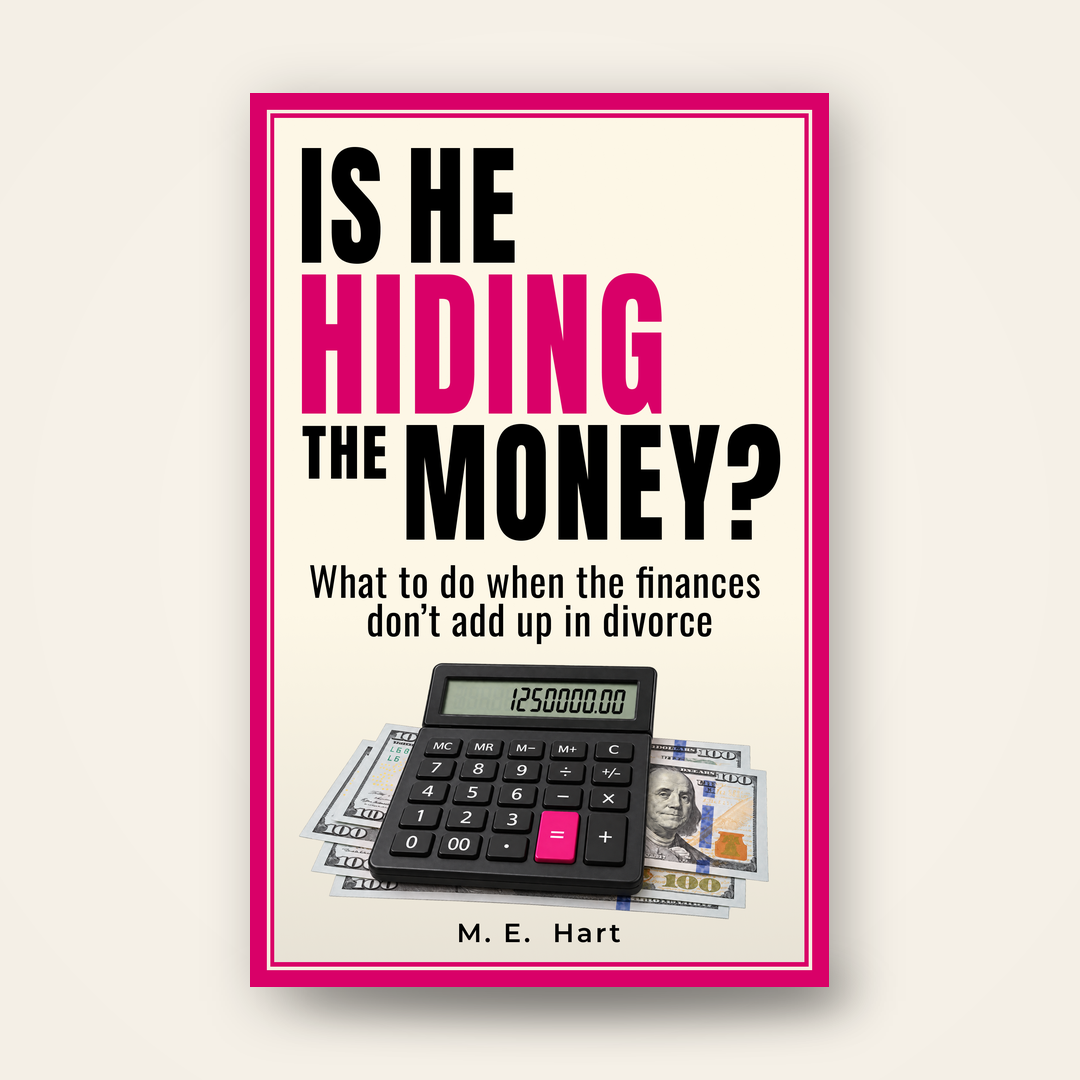
Is He Hiding the Money? What to Do When the Finances Don't Add Up
- ✓How to state what you saw, in five parts and a last line
- ✓The ordinary reasons a correct picture can look wrong
- ✓A gap in the record, or a gap in what you know
- ✓What a forensic accountant does, and who decides it happens
- ✓What to tell your attorney, and what not to do while you wait
One paperback. Free US shipping.
I wish I read this book
20 years ago
Makes you realize how easy it can be for someone to hide money
Making you think about money, trust, and the secrets people may keep

Written by
M. E. Hart
Retired product and customer experience leader with a career in healthcare and insurance.
She spent years translating complicated systems, paperwork and decisions into consumer experiences people could actually use. Retirement In Order applies that same approach to aging, retirement and getting important affairs organized.
Try this first
Five things you can say about what you saw. Most people can say one.
This is the shape the book teaches for each thing you can't account for. Try it on the one that's been keeping you up.
- What did you notice — the thing itself, not what it means?
- Where did you see it — a form, a page, a screen turned toward you?
- Roughly when?
- Which document or account does it touch, if you know?
- What did you expect to see instead?
Answer all five and you have an observation somebody can evaluate. Answer none and you have a worry — which gets reassured away, not looked into.
What each version gets you
| Said as a suspicion | Said as an observation |
|---|---|
| “I think he's hiding money.” | “There's an account on the form I don't recognize.” |
| A feeling an attorney can only reassure you about | A fact an attorney can put a question to |
| A guess about what it means | A gap between what you expected and what the page said |
| Running it again at two in the morning | Five lines on the back of an envelope |
| Something you'd have to prove | Something disclosure and discovery exist to answer |
The sentence you haven't said out loud
Running it again in your head won't tell you anything new
Five ordinary words, and they're hard to say in a normal voice. Part of that is not wanting the answer to be yes. The other part is what asking seems to say about the person asking: you had to have thought it first, and having thought it feels like it has already made you a certain kind of woman.
This book starts there, and then it does the thing most books on the subject won't. There is no list of places money can be hidden in it, no catalog of what is supposed to look suspicious, and no method for reading records yourself. What replaces them is narrower, and it is the part that is actually yours to do.
From the author
Watch: when the numbers stop adding up
An account you don't recognize. A number that doesn't match. A statement that stopped arriving. You don't have to be sure before you're allowed to ask — an unexplained observation is not an accusation.
- ✓ How to document what you're seeing, before you ask
- ✓ Who is actually qualified to help — even if money is tight
- ✓ Captioned · 42 sec · watch right here
Peek inside
See the actual pages
Not descriptions of the pages — the pages. Swipe through, and tap any one to read it full size.
What changes when they arrive
This is what you can do by the time you put it down — not what you'll find out, what you'll be able to say. One paperback, 176 pages, free US shipping.
Say what you saw in a form somebody can act on
Five parts and a last line — the thing itself, where, roughly when, what it touches, what you expected instead — so it arrives as an observation to evaluate, not an accusation to reassure away.
- Why “he handled it” and “he hid it” are different sentences.
- Naming the thing itself, before anybody names what it means.
The five-part statement, at the back of the book
Tell an ordinary gap from something worth raising
Money that never arrives as a statement, two correct numbers that won't sit together, and what a single document was and wasn't built to answer — so you know when the picture is out of shape and when it only looks that way.
- The difference between a gap and evidence.
- How a question actually gets answered: disclosure and discovery.
Four chapters on why a correct picture can look wrong
Know whose job it is, and what not to do while you wait
What a forensic accountant does and who decides it happens, how to tell your attorney what you noticed, and what exists when you can't pay for the help.
- A first legal conversation with a written list, not a blank.
- When money is also being used for control, and the help that names itself.
A one-page map of who answers what
Start tonight
You don't have to know what it means tonight. You can write down what it was.
One thing you can't account for, on the back of an envelope. No book, no login, no drawer.
What you actually saw
Write the thing itself, not what it means. “There's an account on the form I don't recognize” — not “he opened an account”.
Where and when you saw it
Add where you saw it and roughly when. “Sometime after we refinanced” is a real answer, and it beats a confident guess.
What you expected to see
Write what you expected to see instead. The gap between that and what the page said is the part a professional can actually use.
Five lines, and a worry has become an observation. That's the whole difference between being reassured and being answered.
Get what you saw in front of somebody who can answer it.
One paperback. Free US shipping.
What readers say
Every review we have is below — nothing is filtered out.
“I wish I read this book 20 years ago”
I wish I had read this book a long time ago. I wasn't married but I foolishly combined finances and financial responsibilities with someone I was living with. Things were normal, since neither of us had much in the beginning, but things did change. Believe it or not it was his clothing that first alerted to me that something was up. I was the "thing" that made me dig a little deeper. That's when I found out that he wasn't truthful about his finances. Now I recognize that we were not married, but our division of financial responsibilities was built on are income, accounts and any raises. I can tell that this book is not meant to make you this crazy person who follows your partner around or open their mail. But it does a good job of showing the reader what to look out for and to notice when things pop up that are different than normal. This is a great book to read before co mingling finances with someone.
Jocelyn, verified reader · Aug 2026
“Straightforward and actually USEFUL”
This was a really practical read. It breaks down what to pay attention to when the finances in a marriage or divorce just aren't making sense, without making everything feel overly complicated or intimidating. I liked that it focused on actual things to look for, questions to ask & ways to protect yourself instead of just saying "get a lawyer" and leaving it there. It also makes you realize how easy it can be for someone to hide money, move things around or keep financial information from you if you don't know what you're looking at. Definitely a useful read for anyone going through a divorce or even just wanting to understand their household finances better. It's informative, easy to follow & gives you a good starting point for knowing when something just isn't adding up.
@anjaniunfiltered, verified reader · Aug 2026
“Money”
Is He Hiding the Money? is an interesting and thought-provoking book that kept me engaged from beginning to end. The subject matter is intriguing, and the book does a good job of making you think about money, trust, and the secrets people may keep. It was an easy read, with plenty of ideas that stayed with me after finishing it. I would recommend it to anyone who enjoys books that explore financial mysteries and human behavior.
Holly, verified reader · Aug 2026
Read all 8 reviewsHide reviews
“Good idea”
Good information for anyone going through a divorce.
Kerra, verified reader · Sep 2026
“Interesting book”
So there is no list of signs here, no places to look, and no method for reading records yourself. Those belong to a different book, and the reason this one refuses them is not squeamishness: an amateur version of professional work isn't a smaller version of it, and it's unreliable in both directions.
Sara, verified reader · Aug 2026
“Handy knowledge”
This was a handy book to read if you ever have suspected your husband was hiding money from you. It made me think which is always nice when a book does that to you. This would be handy to someone to read if they might be going through a divorce.
Verified reader · Sep 2026
“Good information”
This was a good book. It sheds some light on how to navigate the tricky situation of divorce and finances. I recommend this book to anyone who would benefit from reading how to go through this difficult time with a little bit more ease.
Ashten, verified reader · Aug 2026
“Is He Hiding the Money”
s He Hiding the Money? is a practical and informative book about financial concerns that can arise during divorce. It helps readers understand the importance of paying attention to finances and recognizing possible signs that money or assets may not be fully disclosed. The book offers useful information for anyone going through a divorce and wanting to better understand and protect their financial interests.
Melissa, verified reader · Aug 2026
Where the answers come from
Not a list of signs. The people whose job this is.
There's no catalog of red flags in this book, on purpose: an untrained reader running one produces false alarms and false comfort in about equal measure, and in a live case both cost money. What it names instead is the mechanism that actually answers the question, and the person who runs it.
- Court disclosure & discoveryWhat each side has to produce, and how it is compelled
- Forensic accountantsWhat their work produces, and who decides it happens
- Your attorneyWhich observation can be acted on, and how
- Civil legal aid & bar referral servicesHelp that exists when you can't pay for it
Good to know
Common questions
Will this book tell me whether he's hiding money?
No, and that is the first thing it says. Nobody who hasn't seen the actual records, in your actual situation, can tell you what an unexplained observation means. It also won't tell you there's probably an innocent explanation — that sentence is exactly as unsupported as the alarming one, and it sounds responsible while closing the question instead of answering it. What the book does is get the question into the hands of somebody who can answer it, in a form they can work with.
What does it actually cover?
Sixteen chapters in four parts: how to say precisely what you noticed, in five parts and a last line; the ordinary reasons a picture looks wrong when nothing is wrong — money that never arrives as a statement, two accurate figures that diverge, what a single document was built to answer; the difference between a gap and evidence; how financial disclosure and discovery actually work and what varies by state; what a forensic accountant does and who decides whether it happens; what to tell your attorney in the first hour, and what not to do while you wait. It ends with five reference sheets.
Is this legal or financial advice?
No. Divorce law is state law, your facts are your own, and no book has seen them. This is educational information about how these questions are handled and who has the authority to answer each one — not what to do about your case. Take the specifics to a family-law attorney, a tax professional, your plan administrator or your insurer, and confirm current rules at the source.
Is it still useful if I already have a lawyer?
That's usually who it's written for. The chapter on telling your attorney what you noticed exists because the same observation lands very differently depending on how it's said — a vague worry gets reassurance, a precise statement gets evaluated. Several of the questions that keep a person awake also belong to a plan administrator, a lender or an insurer rather than to counsel, and nobody in the case has a particular reason to raise those with you.
What if I can't afford a forensic accountant?
Chapter 15 is about exactly that, and it names what exists rather than telling you to find a way: civil legal aid, limited-scope representation, bar association referral services, law school clinics, court self-help centers, and the mechanism by which a court can in some states order one spouse to contribute to the other's legal fees. Eligibility rules vary and each program answers for itself, which is what makes those questions worth asking rather than settling in your own kitchen.
There is an unsafe situation in my marriage. Is that in the book?
Yes, twice, and both were written to be found without reading anything around them. A short sheet sits in the front matter, before Chapter 1, and Chapter 14 is a full chapter on money used as control. If you are in danger right now, that is a call to make before a book.
Is this the right book for me?
Only if you've already seen something specific: an account you don't recognize, statements that used to arrive and stopped, two numbers for one thing that won't sit together. The book turns that into five parts a professional can work with. It's the wrong book if what you want is a checklist of warning signs, because there isn't one in here on purpose — and if you're still learning what the documents say, the companion volume He Handled the Money is the better start.
What if it isn't right for me?
Each book is printed for you one copy at a time. If your parcel turns up damaged or misprinted, send a photo within 30 days and we ship a replacement free — you keep the flawed copy. Because every copy is made to order, we can't take a book back once it has shipped. Contact details are at the bottom of this page.
Your next step
Get what you saw in front of somebody who can answer it.
The observation, the ordinary explanations, and whose desk it belongs on.
How to say exactly what you noticed, how to tell a gap from evidence, and who has the authority to answer it — with a chapter on what not to do while you wait. One paperback, posted to you.
What the money buys against isn't a book. It's a real question, reassured away because it was said as a feeling.
One paperback. Free US shipping.
You may also be interested in


Start getting retirement in order — one simple checklist at a time
Free quick-start checklists to help you organize the practical parts of retirement: what to gather, what to decide, and what to write down first.
- What to gather
- What to update
- What to share with family
Almost there — check your inbox.
We just sent a confirmation email. Click the link inside and your free download lands right after. (If you don't see it, check spam or promotions.)
 Is He Hiding the Money?$25.99Paperback
$25.99Paperback
Is He Hiding the Money?$25.99Paperback
$25.99Paperback
