Paperback
Care doesn't arrive on its own. Somebody has to run it.
There's the care — bathing, dressing, driving. Then there's running it: finding it, pricing it, hiring it, and checking week after week that it's still happening. With no spouse and no adult child nearby, both jobs are yours.
Long-Term Care on Your Own
- ✓The four kinds of help long-term care actually covers
- ✓What it costs by the hour, and what Medicare does not pay
- ✓The Care Management Map — one row per job, and the blanks
- ✓Agency or direct hire, and what each makes you responsible for
- ✓When home stops working, comparing the settings honestly
One paperback. Free US shipping.
Finally names the invisible second job of long-term care
This book is a great addition to your elderly care plan.
It's straightforward, realistic, and sometimes a little uncomfortable

Written by
M. E. Hart
Retired product and customer experience leader with a career in healthcare and insurance.
She spent years translating complicated systems, paperwork and decisions into consumer experiences people could actually use. Retirement In Order applies that same approach to aging, retirement and getting important affairs organized.
Try this first
Six jobs, and no second adult in the house.
Picture the week help starts. Every line below is somebody's job from that Monday on, and in most households they get split between two or three people without anyone naming them.
- Who calls the agency at eight in the morning?
- Who checks the aide actually turned up?
- Who knows what an hour costs where you live?
- Who finds out what Medicare won't pay for?
- Who picks you up after the procedure?
- Who takes it over when you can't run it?
Alone, the six aren't split at all. They're one list, and it's yours.
What the job looks like either way
| Worked out on the day | Worked out first |
|---|---|
| You start ringing agencies from a hospital chair | A shortlist you made on an ordinary Tuesday |
| You learn the hourly rate while you're booking | A figure you already checked for your own county |
| Nobody notices when the care starts slipping | One page a week, and what to look at on it |
| You find out where Medicare stopped afterwards | You knew where it stopped before you started |
| The handover happens in a crisis, to whoever's near | A professional you vetted while you were well |
Six jobs, and a fill-in tool inside for each of them.
For the person with no one to hand it to
You are the one who has to arrange it
Long-term care is usually described as something that happens to a family. Somebody notices. Somebody calls. Somebody drives. If you are unmarried, widowed, or your children are grown and far away, there is no somebody — there is you, on hold with an agency at eight in the morning, trying to work out who is even allowed to answer your question.
This book is about that work: the arranging, not the bathing. It runs from what long-term care actually is, through what it costs and what pays for it, into hiring and running the care, and out the far side to the day you can't run it yourself and have to hand it to somebody you picked on purpose.
From the author
Watch: when there's no one else to call
Most long-term care advice assumes somebody is standing next to you. If that person doesn't exist, you can still plan this yourself — there's an order to it, and this book walks you through it.
- ✓ What to decide, and who to line up, before you need care
- ✓ The advice that stops working when nobody is standing next to you
- ✓ Captioned · 36 sec · watch right here
Peek inside
See the actual pages
Not descriptions of the pages — the pages. Swipe through, and tap any one to read it full size.
What changes when they arrive
This is what's settled by the time you put it down. One paperback, 294 pages, free US shipping.
Know what an hour of help costs, and what actually pays for it
Four kinds of help priced by the hour, where Medicare stops, and the public front doors that come before you start paying privately.
- What Medicare does here, and the longer list it doesn't.
- Which programs your county actually runs, and the call that confirms it.
Every figure cited, every route with a local call attached
Be able to hire somebody, and check the care is happening
Agency or direct hire, what each makes you responsible for, the questions that vet a stranger, and the week-to-week job of watching it.
- The hiring questions, and what an acceptable answer has to contain.
- Scope, the agreement, and what to do the week it slips.
Nine tools, the Care Management Map among them
Have somebody to hand it to before you have to
The professional backup you vetted while you were well, and the honest signs that the arrangement at home has come to an end.
- Who takes the manager's job on the day you can't do it.
- The settings compared without a brochure in front of you.
One row per job — the blanks are what's still unassigned
Start this weekend
You can't buy a care plan this weekend. You can start one.
Three searches and a call. None of them needs the book open.
Price an hour of help in your county
Look up what an hour of home help costs where you live. One search, and it stops being an abstraction.
Put your Area Agency on Aging in your phone
Find it by name and save the number. It is the front door to almost every public route.
Write down who you'd ring first
The person you'd call at seven on a Monday morning. Then write who you'd ring if that person didn't pick up.
Fifteen minutes, and you'll know which of the six jobs currently has nobody's name on it.
Settle the second job before it starts.
One paperback. Free US shipping.
What readers say
Every review we have is below — nothing is filtered out.
“A Guide for the Solo Ager”
That opening scene the Tuesday morning aide who never shows, leaving the woman in the apartment unaware of the two hours of frantic phone calls happening behind the scenes to fix her week hit me like a gut punch. This book finally names the invisible second job of long-term care, the one that nobody pictures when they imagine needing help. The author walks you through every terrifying blank on that Care Management Map at the back with such patient, unflinching clarity that I felt less alone just reading it. M.E. Hart doesn't sell false comfort, she hands you a flashlight and a map, then sits beside you while you figure out which caverns are yours to cross alone.
Chantal, verified reader · Sep 2026
“Planning for the Days We Cannot Predict”
Life is fragile, and it can change in the blink of an eye. You can wake up on an ordinary Friday morning with nothing out of the ordinary, never imagining that you may not see the next day—or that your health could suddenly change and lead to doctor’s appointments, hospital visits, and decisions you never expected to face. I believe deeply in the providence of God. I didn’t know when I was coming into this world, and I don’t know when I will leave it. But trusting God doesn’t mean I shouldn’t prepare for the years ahead. That is what drew me to Retirement in Order: Long-Term Care on Your Own. This book provides a sense of structure and a practical framework for thinking about something many of us would rather avoid: How will I care for myself if I grow older without a spouse or adult children to rely on? As someone without children, I found this perspective especially meaningful. Retirement planning is often presented around the traditional family structure, but not everyone will have a spouse, children, or relatives available to step in when they need assistance. That doesn’t mean we should approach the future with fear; it means we can approach it with intention. This book encourages readers to think ahead about long-term care, support systems, finances, housing, decision-making, and the practical realities of aging independently. For me, the biggest takeaway is that planning for my latter days isn’t a lack of faith—it can actually be an act of stewardship. I may not know what tomorrow holds, but I can make thoughtful decisions today that give my future self more options, dignity, and peace. If you are aging without a spouse or adult children, or simply want to be more intentional about your later years, this is a guide worth picking up. We cannot control how life unfolds, but we can prepare for the possibilities while trusting God with the outcome.
Youde, verified reader · Oct 2026
“A Masterclass in Systems Architecture for Solo Aging”
Most retirement guides tend to treat aging like a sentimental postcard or a sudden medical emergency, completely ignoring the administrative engine required to hold a life together, but this book cuts through all of that noise with refreshing clarity. When most people think of needing help, they picture an aide assisting with a transfer or fixing a meal, but they completely miss the invisible "second-job" that is the hours spent on the phone disputing billing codes, managing fractured agency schedules, handling pharmacy mishaps, and reconciling doctors who never talk to each other. For those aging without an automatic co-pilot like a spouse or nearby adult children, an unmanaged system will fail at the seams. Hart treats this as a systems-and-logistics problem requiring clear operational boundaries, and not as an emotional tragedy. The book forces you to look at your actual blind spots and systematically assign owners, backups, or honest question marks to every critical life function. If you value self-reliance, systems thinking, and actionable architecture over hand-wringing platitudes, read this book; build the map, ask the uncomfortable questions early, and get your operational framework on paper while you're still standing on your own two feet.
Anthony, verified reader · Oct 2026
Read all 22 reviewsHide reviews
“Planning for Care When You're on Your Own”
What I find most useful about this guide is that it looks beyond receiving care and explains who will actually manage everything behind the scenes. Finding reliable help, handling schedules, checking services, and arranging backup are easy things to overlook until they become urgent. The nine planning tools also sound practical, especially the first-call list and care management map. I appreciate that the book acknowledges local differences instead of pretending one plan works for everyone. It feels thoughtful and realistic for anyone preparing to age independently.
Tracy, verified reader · Oct 2026
“Good Book”
It's a sad thing to be alone. I watched this with my sister. She would just sit in her room and wait to pass on. I wish I had this guide to give to her. But now I find that I'm in the same situation with my older brother who lost his wife and seem stuck. So I got this for him to hopefully help him make a turnaround and make some plans as he gets older. So we'll know what to do or what he wants to do. This is one of those books you should have in your library whether you are alone or not. We all know someone that's aging and along and maybe this will help them.
Cheryl, verified reader · Oct 2026
“A Practical Plan for Aging Independently”
What I appreciate about this guide is that it covers the work behind arranging long-term care, not just the care itself. Finding reliable help, managing schedules, checking services, and having a backup plan are important details that people can easily overlook. The planning worksheets sound especially useful, particularly the care management map and first-call list. I also like that the book acknowledges that local services differ and encourages readers to find out what applies to them. It feels realistic and thoughtfully organized for solo agers.
Trent, verified reader · Oct 2026
“Long term care on your own”
This book is a great addition to your elderly care plan. It will help you along with planning for your self care as you age. It also gives pointers on what Medicare covers and the basics and how to for daily care from hospital, being at home alone and employing outside help if you don't have a family member close by or present. It's great information that can assist you in making an informed decision on you long term care.
Hidy, verified reader · Aug 2026
“Very good guide”
I'm someone who is hyper independent so I really like this book to help with figuring this out for when I do get older. I have a plan and an idea. This was really helpful to do that
Krystal, verified reader · Oct 2026
“Very helpful for planning”
Very helpful and brought to my attention categories of needs I would not have thought about on my own. It is a good type of book to go back and reference as needed as well.
Tori, verified reader · Oct 2026
“Book For Those Planning On Retiring Now Or In The Future”
A Very Interesting Book to Read for Those who want to plan or are planning to retire. A++
Robyn, verified reader · Aug 2026
“Its life”
Extremely helpful and beneficial if you are having to experience Long Term Care.
Heather, verified reader · Oct 2026
“Important Information”
This book has a lot of great information for those of without children.
Bridgett, verified reader · Oct 2026
“Long term self care”
This book covers an important topic for people who may need to plan for their future without a spouse or adult children to depend on. It focuses on preparing for long-term care, making important decisions, and finding resources to maintain independence as people age. I like that the subject encourages readers to think ahead instead of waiting until they need help. However, planning for the future can feel overwhelming, so having practical steps and clear explanations is important. Overall, this book could be a helpful resource for individuals who want to feel more prepared and confident about aging independently.
Jayden, verified reader · Oct 2026
“Planning Beyond the Care Itself”
I appreciated how this book looks at long-term care from a practical angle that is easy to overlook: who actually manages everything when help is needed. The distinction between receiving care and coordinating care stood out to me. I also liked the planning tools, especially the first-call list, hiring questions, and care management map. Rather than making assumptions about where readers live or what resources they have, the book encourages them to identify what applies locally. The focus on backup plans and eventually handing over responsibilities makes the subject feel more manageable and concrete.
Nathan, verified reader · Sep 2026
“A necessary book”
“Picture yourself needing care someday.” This is a practical, professional, and very detailed book. It brims with data, probably many of us have never thought of needing. So yes, it is a good, a helpful, and a necessary book. The only setback (maybe just for me), is the somewhat cool delivery. Nevertheless, this is a great source of relevant information to keep handy.
Carna, verified reader · Oct 2026
“Planning for your parents”
Long Term Care On Your Own is a practical and reassuring guide for people planning for aging without a spouse or adult children to rely on. The straightforward advice on preparing for future care needs, organizing important decisions, and maintaining independence makes it a helpful resource for anyone navigating solo aging.
Amber, verified reader · Oct 2026
“Recommend”
It's straightforward, realistic, and sometimes a little uncomfortable which is why I found it useful. It made me realize that the best time to figure out who will manage my care is while I'm still capable of making the decisions myself.
Kayla, verified reader · Aug 2026
“Long term care on your own”
This guide helps you to cope with aging when you are on your own. It helps you to plan for what it could be like when you are elderly and alone.
Tanya, verified reader · Oct 2026
“Insightful”
Very insightful. Brought this book for an elderly friend of mine and they really appreciate the tips on navigating as they get older.
Verified reader · Oct 2026
“Long Term Care On Your Own”
It's a very straightforward book, it talks about all of the necessary topics that should be discussed as you get older.
Riley, verified reader · Aug 2026
“Informative, but Nothing That Really Stood Out”
This book was okay, but I wouldn’t say it was anything exceptional. The concept is definitely useful, especially for people who are planning for their future without a spouse or adult children to rely on. It touches on an important topic that doesn’t always get enough attention. However, I was hoping for something a little more detailed and engaging. While there is some helpful information, I didn’t feel like it offered anything particularly groundbreaking. It’s a decent starting point for someone beginning to think about long-term care planning, but I wouldn’t rely on it as my only resource. Overall, not a bad book, just not one that really impressed me.
Jazmyn, verified reader · Oct 2026
“Good read”
this book was alright just not exactly what i thought it would be
Rhonda, verified reader · Oct 2026
Where the numbers come from
Every route comes with the local call that confirms it.
A national programme description is a lead, not a fact — what runs where you live is decided locally, by somebody with a phone number. This book names the body that decides each one, on the page where the rule is used.
- MedicareLimited skilled care, not ongoing custodial care
- MedicaidWho qualifies for help with long-term care
- County aging agenciesWhich programs actually run where you live
Good to know
Common questions
Who is this book for?
The person who has to arrange their own care and has no obvious second name to put on the form — never married, divorced, widowed, child-free, or with adult children too far away to make a Tuesday-morning phone call. It is written to you, not about you, and it does not use the adult-child framing that most eldercare books run on. If you are arranging care for a parent instead, Caregiving Without Losing Yourself is the one for that job.
Does Medicare pay for long-term care?
Mostly not, and the book spends a full chapter on exactly where the line falls. Medicare is built around medical treatment and recovery, not the day-to-day help with bathing, dressing, and eating that long-term care actually means — and the pieces it does cover come with conditions people usually discover at the worst moment. The chapter walks the difference, then a second chapter covers what does pay for the hours. Program rules vary by state and change, so the book routes you to the office that can confirm yours rather than quoting a figure that expires.
Should I hire through an agency or hire someone directly?
It depends on what you are willing to be responsible for, and the book lays out both columns rather than picking for you. Hiring directly usually costs less per hour and makes you the employer, with everything that word carries — taxes, coverage when your person is sick, and no backup at seven in the morning. An agency charges more and absorbs some of that. There is a full chapter on the trade, another on vetting and writing the scope of work down, and a fill-in page of hiring questions in the back.
Who do I name if I have no spouse and no children?
That is the question the last part of the book is built around. It covers what a care arrangement actually asks someone to be able to do, the difference between naming a person and naming a professional, and how to check a professional — a care manager, a fiduciary, an elder-law attorney — before you hand anything over. There is a fill-in tool for it too: Questions I Need Answered About Authority. What the documents are called and what they can do varies by state, so it sends you to an elder-law attorney to make it real.
Does it tell me whether to buy long-term care insurance?
No, and that is deliberate. It is not an insurance book and it does not sell one — it also does not teach Medicaid asset strategy. What it does is show you the arithmetic underneath those decisions: what care costs by the hour where you live, how many hours a real week takes, and what already pays for some of them. That is the number you would take to an adviser, and it is the number most people never work out.
What are the fill-in tools in the back?
Nine of them across thirty pages, eight of which take writing: the Care Management Map (one row per job that has to keep happening, and who does it), My First-Call List, Questions I Need Answered About Authority, Checking a Professional Before You Hire, My Hiring Questions, When to Revisit the Plan, My Discharge Sheet, Where to Start Looking, and My Unresolved Gaps. They are made to be photocopied and redone as things change.
Is this legal, financial, or medical advice?
No. It is educational — a plain-English guide to the decisions, the programs, and the questions, with every figure and rule drawn from primary sources and cited. Program availability and legal documents vary by state and change, so the book names the local office or professional that confirms your situation instead of pretending a national description settles it.
What format does it come in?
A 294-page paperback, printed when you order and mailed to you — free US shipping, about two weeks. Published under the pen name M. E. Hart as part of the Retirement In Order series.
Who is this book not for?
The family caregiver arranging a parent's care — that's Caregiving Without Losing Yourself, and this one assumes the person reading it is the one who'll need the care. It also won't tell you whether to buy long-term care insurance; it lays out what the policies do and leaves the decision priced rather than answered. And if you have a spouse or an adult child nearby who will run it, the hiring and oversight chapters are solving a problem you don't have.
How current are the cost and coverage figures?
Every figure and program rule was verified in 2026 against the primary source and cited in the text: Medicare.gov and CMS for what Medicare does and does not pay, and the federal Administration for Community Living for the aging and disability resource network you call first. Hourly care rates are regional and move every year, so price your own area before you budget from any national number.
What if it isn't right for me?
Each book is printed for you one copy at a time. If your parcel turns up damaged or misprinted, send a photo within 30 days and we ship a replacement free — you keep the flawed copy. Because every copy is made to order, we can't take a book back once it has shipped. Contact details are at the bottom of this page.
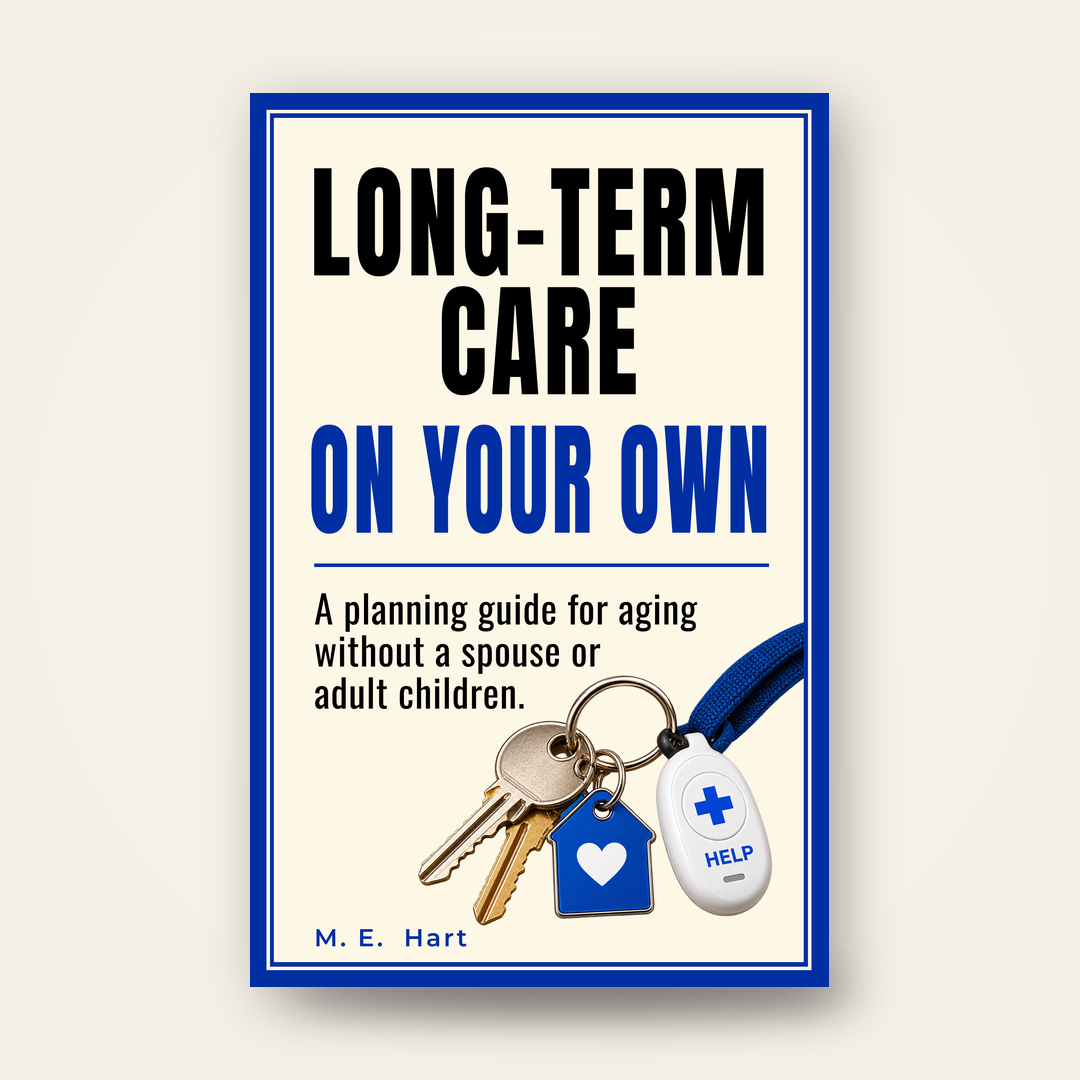
Your next step
Settle the second job before it starts.
Finding it, pricing it, hiring it, watching it — and handing it over.
What care costs by the hour, where Medicare stops paying, how to hire somebody and check the care is happening, and who takes it over when you can't. One paperback, posted to you.
What the money buys against isn't a book. It's six jobs landing on one person in the same week.
One paperback. Free US shipping.
You may also be interested in


Start getting retirement in order — one simple checklist at a time
Free quick-start checklists to help you organize the practical parts of retirement: what to gather, what to decide, and what to write down first.
- What to gather
- What to update
- What to share with family
Almost there — check your inbox.
We just sent a confirmation email. Click the link inside and your free download lands right after. (If you don't see it, check spam or promotions.)
 Long-Term Care on Your Own$28.99Paperback
$28.99Paperback
Long-Term Care on Your Own$28.99Paperback
$28.99Paperback
