Paperback · 164 pages
Everyone asks how your parent is doing. Nobody asks what it's costing you.
What to say when a parent refuses help. How to read a Medicare denial. How to get a sibling who isn't showing up to show up. Specific problems, specific options, no encouragement.
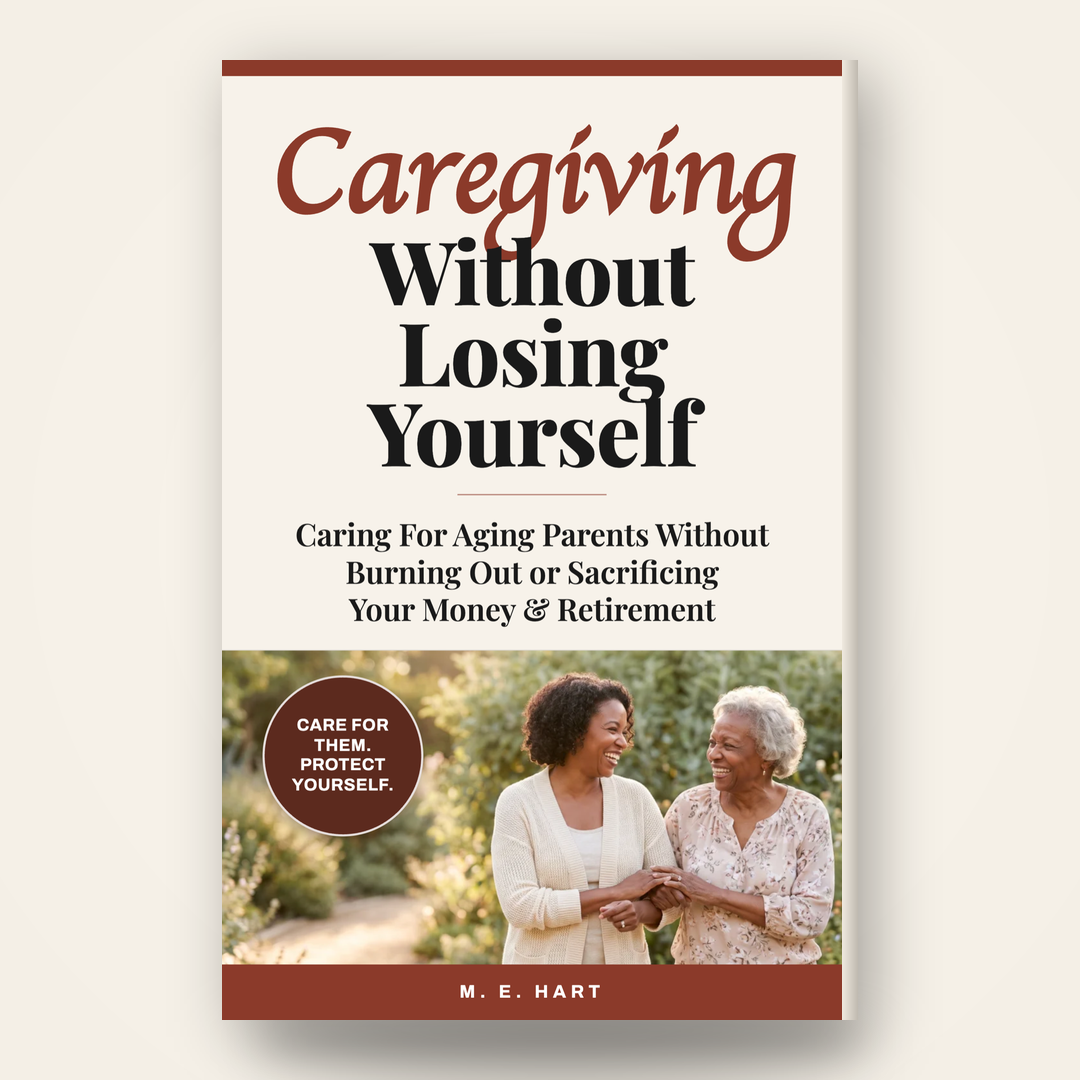
Caregiving Without Losing Yourself
- ✓The guilt and resentment nobody says out loud
- ✓Word-for-word scripts for the conversations you dread
- ✓The account-access ladder — and why not the joint account
- ✓What caregiving costs your wages, Social Security and FMLA
- ✓Medicare's 100-day limit and the observation-status trap
- ✓One thing to do this week, at the end of every chapter
One paperback. Free US shipping.
It's ok, to set boundaries. It's ok to say no.
My mom never took a day off and she got so worn out. She needed to.
Not many people have the words to explain the emotions around caregiving.
Try this first
Six questions, and the honest answer to each.
Nobody hands you this job with a list. Answer these the way things stand today — the real version, not the one you'd say out loud at Thanksgiving.
- When was your last full day off?
- What has this cost your own Social Security so far?
- Whose name is on the account you pay their bills from?
- What happens on day 101 in the nursing home?
- When did your sibling last take a shift?
- Who decides when the car keys go?
Most caregivers can't answer three of them. That isn't a failing. It's the part nobody covers.
What each blank costs
| Worked out as you go | Worked out first |
|---|---|
| The day off never comes | Boundaries set while you can hold them |
| Fewer hours, a smaller benefit | Paid leave and the tax breaks, checked first |
| Your name goes on the joint account | A durable POA — their money stays theirs |
| Day 101 arrives as an invoice | You knew on day one where Medicare stops |
| Siblings' shares settled in the ER | A share agreed before anyone's in a crisis |
Six questions, and a chapter behind each one.
For the adult child in the middle of it
You became the caregiver. Don't disappear into it.
One phone call and suddenly you're running someone else's health, money, and safety on top of your own life. Everyone tells you to “take care of yourself,” and no one tells you how. This is the how — a candid, been-there friend who refuses to let caring for your parent cost you your health, your savings, and your own retirement.
It's written for the one who showed up — often the daughter, often the single sibling doing the most. It walks you past the guilt and the boundary battles, through the money and the medical systems, all the way to the long goodbye, and it keeps you in the room the whole time.
From the author
Watch: look at your own numbers too
What you spend caring for a parent comes straight out of your own retirement — and it never shows up as a line item anywhere. Make it one, before the years add up.
- ✓ The caregiving costs nobody puts in a budget
- ✓ Why lost hours hit your Social Security too
- ✓ Captioned · 23 sec · watch right here
Peek inside
See the actual pages
Not a description of the pages — the pages. Click any one to read it full size.
Know the moment for what it is
Hear the 2 a.m. fear answered
Know what it takes out of you
What changes when they arrive
This is what's settled by the time you put it down. One paperback, 164 pages, free US shipping.
Set a boundary and hold it, with the words to use
The guilt and resentment named out loud, the burnout signs before they flatten you, and scripts for the conversations you've been putting off.
- What to say when a parent refuses help.
- How to say no to a sibling, a doctor, or your mother.
Word-for-word scripts, and one thing to do at the end of every chapter
Know what this is costing you, and stop the part you can
The caregiving tax on your wages and your Social Security record, FMLA and state paid leave, and the tax breaks family caregivers miss.
- What cutting your hours does to your own retirement.
- Which leave you're entitled to before you resign.
Every figure drawn from the SSA, the IRS, Medicare and the VA
Work Medicare, Medicaid and the VA instead of being worked by them
Where Medicare's 100 days actually stop, the observation-status trap, the Medicaid spend-down and look-back, and the VA routes if your parent served.
- How to read a denial, and what to do the same week.
- The programs that pay a family member to caregive.
Each program named with the body that decides it
Start this week
You can't fix caregiving this week. You can find out what it's costing.
Three things, none of them needing the book open.
Log in to my Social Security and look at your earnings record. Find the year the number dropped, if it has. That's the caregiving tax, in your own figures.
Look up whose name is on the account you pay your parent's bills from. If yours is on it too, write down when that happened.
Write down the date of your last full day off. If you have to think about it, that's the answer.
Twenty minutes, and the cost stops being a feeling and starts being a number.
Stay the caregiver. Don't become the second patient.
One paperback. Free US shipping.
What readers say
Every review we have is below — nothing is filtered out.
“Good lessons”
This book has great lessons. This we caregivers tend to forget and boundaries we deny. This book reminds you it's ok, to set boundaries. It's ok to say no. Its ok to not be ok.
Lhunter, verified reader · Aug 2026
“Thoughtful and practical”
Having previously worked in the caregiving industry, I found this to be a thoughtful and practical read. While it's clearly geared toward those caring for aging parents, I think a lot of the advice and perspective can apply to caregiving more broadly. It touches on some important realities of the role while also emphasizing the importance of not losing yourself in the process. In summary, this felt like a useful resource for anyone navigating caregiving, whether you're currently in that position or simply want a better understanding of what it can involve.
Kat, verified reader · Sep 2026
“Very helpful and insightful read”
Becoming a caregiver to a lover one is a challenging ordeal especially if you are doing it alone. This book covers topics such as setting boundaries, protecting your money and your loved ones money, dealing with siblings and sharing the burden. They also talk about dealing with feelings of burnout, guilt and resentment and how all are normal. This is a great book on how to handle all the things that come along with caring for a sick loved one.
Rachel, verified reader · Aug 2026
Read all 5 reviewsHide reviews
“A better understanding”
This was helpful to understand what you should be expecting. I watched my mom just go through this with my grandmother. It tells you you shouldn't feel guilty for taking a day off. My mom never took a day off and she got so worn out. She needed to.
Dani, verified reader · Jul 2026
“Great”
Not many people have the words to explain the emotions around caregiving. This book does talk a lot about taking care of your parents and how that role really shapes your new life. It was interesting and very useful.
Jeanie, verified reader · Jul 2026
Where the numbers come from
Every program named with the body that decides it.
A caregiving book that says “check with Medicare” has told you nothing. This one names which rule, which office and what to ask, on the page where the decision comes up.
- MedicareHow many skilled-nursing days it pays for, and when a stay counts
- Social Security AdministrationWhat a gap in your earnings record does to your own benefit
- The VAWhether your parent's service opens a route to help paying for care

Retirement In Order is written under the pen name M. E. Hart — a retired product leader who spent a career in healthcare and insurance, the two industries built on exactly the paperwork most families dread.
Good to know
Common questions
What are the signs of caregiver burnout?
The ones people recognize late: sleeping badly and waking at the same hour every night, snapping at the parent you are trying to help, dropping your own appointments, and a resentment you would never say out loud. The book opens there rather than at the definition — how to spot it before it flattens you, and the boundaries that hold with a parent and with the siblings who aren't showing up.
Can I get paid to care for my parent?
Sometimes, and the routes are specific enough to be worth checking: Medicaid self-directed care programs, VA benefits if your parent served, and tax breaks family caregivers routinely miss. The chapter on working the systems covers what Medicare does and doesn't cover, Medicaid spend-down and the look-back, the VA, and getting paid to caregive. What you qualify for turns on your parent's state and their eligibility, so the book routes you to the program rather than quoting a number that expires.
How do I keep caregiving from wrecking my own retirement?
By pricing it before it happens. Unpaid caregiving costs you wages, Social Security credits and retirement contributions at the same time, and it usually lands in the years those compound hardest. There's a full chapter on the caregiving tax on wages and Social Security, FMLA and state paid family leave, the tax breaks most caregivers miss, and guarding your parent's money against fraud while you're in there anyway.
Should I get this or the Caregiver Bundle?
This book is the one for the caring itself — burnout, boundaries, the systems, the hard calls. If you also have to get your parent's paperwork together, the Caregiver Bundle pairs it with the 80-page fill-in organizer you work through with them, in one parcel. Take this one on its own if the paperwork is already handled.
What's the free Caregiver's Financial-Protection Checklist?
A free two-page printable companion to the book's money chapters — the accounts to set up, the documents to sign, the fraud red flags to watch, and the questions to ask about Medicaid, the VA, and taxes. It's free at RetirementInOrder.com/caregiver-toolkit and it's how the plan in the book becomes a done list.
Is this legal, tax, or medical advice?
No. It's educational — a plain-English guide to the decisions, documents, and programs, with every figure and rule drawn from primary sources and cited. Laws, dollar figures, and program rules vary by state and change, so the book routes you to your state's programs and the right professionals (an elder-law or estate attorney, a tax pro, your clinicians) to make it real.
What format does it come in?
A paperback, printed when you order and mailed to you — free US shipping, about two weeks. Published under the pen name M. E. Hart as part of the Retirement In Order series.
Is this the right book for me?
It's for the unpaid family member who now handles a parent's appointments, bills and safety on top of a job. It isn't a medical book about your parent's diagnosis, and it isn't written for your parent to read — it's written to you, including the parts about resentment and what this is costing your own Social Security. If you're a paid professional caregiver, the money chapters won't apply.
How current are the Medicare and Medicaid figures?
Every program rule, dollar figure and day count was verified in 2026 against the primary source and cited in the text: Medicare.gov and CMS for the 100-day limit and observation status, Medicaid.gov for eligibility and the look-back, the VA for its benefits, and the Department of Labor for FMLA. These rules change, so confirm anything you're about to act on at the source before you file or appeal.
What if it isn't right for me?
Each book is printed for you one copy at a time. If your parcel turns up damaged or misprinted, send a photo within 30 days and we ship a replacement free — you keep the flawed copy. Because every copy is made to order, we can't take a book back once it has shipped. Contact details are at the bottom of this page.
Your next step
Stay the caregiver. Don't become the second patient.
The boundaries, the money, the systems and the hard calls — with you still standing at the end.
How to set a boundary and hold it, what caregiving is costing your wages and Social Security, where Medicare stops and Medicaid starts, and how to make the hard calls without making them alone. One paperback, posted to you.
What the money buys against isn't a book. It's the years off your own retirement this job takes when nobody prices it.
One paperback. Free US shipping.
Free companion
The Caregiver's Financial-Protection Checklist
The free two-page companion from the money chapters — the accounts to set up, the documents to sign, and the fraud red flags to watch. Free.
Get the free checklistMore free tools: Medicare Enrollment Calendar · Senior Discounts · Brain Games
You may also be interested in


Start getting retirement in order — one simple checklist at a time
Free quick-start checklists to help you organize the practical parts of retirement: what to gather, what to decide, and what to write down first.
- What to gather
- What to update
- What to share with family
Almost there — check your inbox.
We just sent a confirmation email. Click the link inside and your free download lands right after. (If you don't see it, check spam or promotions.)
