Paperback
Most safety advice ends with “call someone.” What if there's no one to call?
When you live alone, you may be the only one who notices a scam, questions a stranger, or responds to an emergency. This book gives you the words, safeguards, and step-by-step plans to protect yourself—even without someone else to step in.
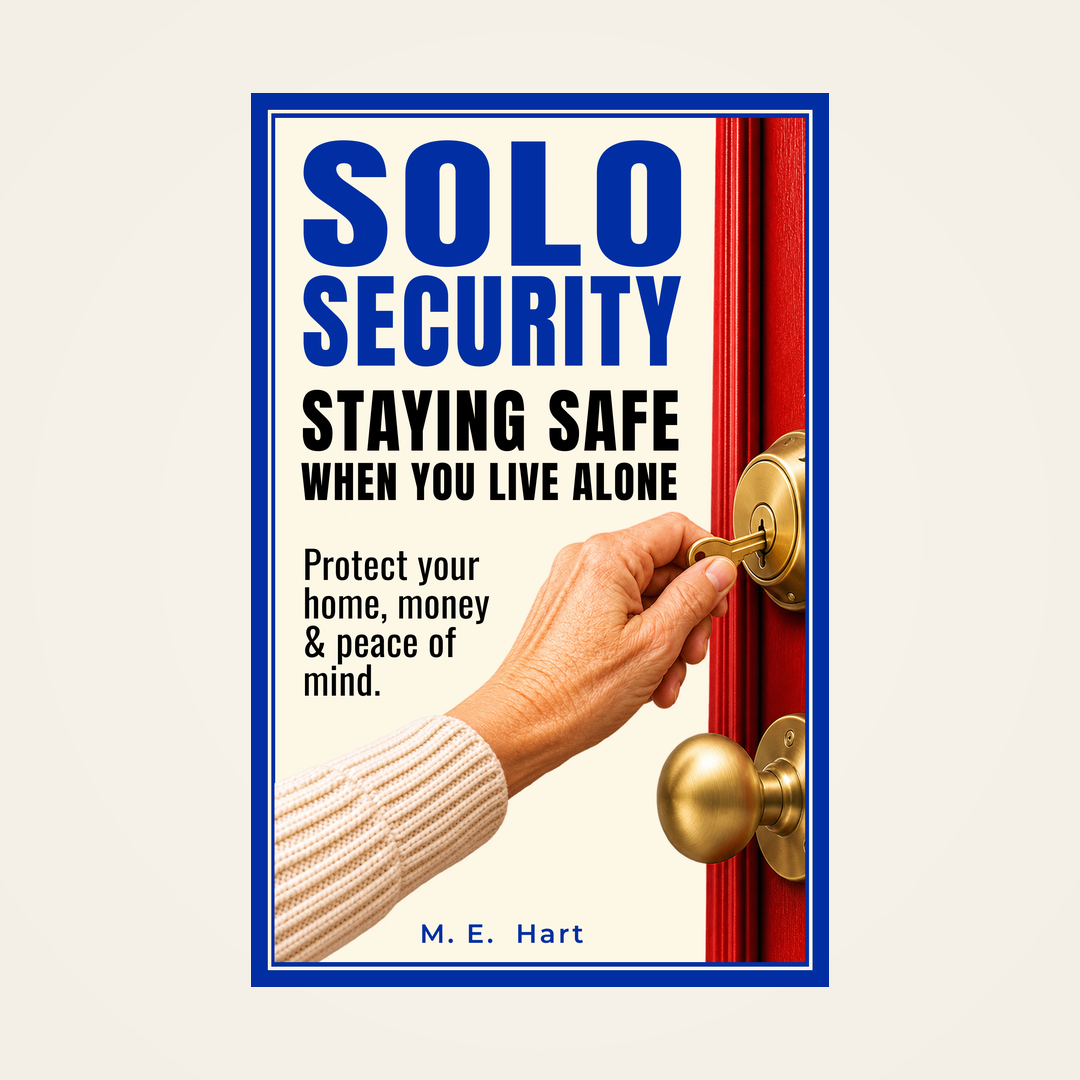
Solo Security: Staying Safe Alone
- ✓Know exactly what to say to suspicious callers and strangers
- ✓Make your doors, accounts, and personal information safer
- ✓Set alerts and protections that don't depend on family
- ✓Know your next steps after fraud, a fall, or an emergency
- ✓Quick-reference safety cards and a prioritized 30-day plan
One paperback. Free US shipping.

Written by
M. E. Hart
Retired product and customer experience leader with a career in healthcare and insurance.
She spent years translating complicated systems, paperwork and decisions into consumer experiences people could actually use. Retirement In Order applies that same approach to aging, retirement and getting important affairs organized.
Picture this
Six ordinary moments. Six decisions you're making alone.
None of these situations requires you to be careless. But when you live alone, there's no automatic second set of eyes.
- Your bank calls. Is it really your bank?
- Someone you met online needs money.
- A stranger knocks and says they need to come inside.
- Someone still has your house key or garage code.
- You fall, and nobody knows you're down.
- Money is gone. Who do you call first?
The same moment, either way
| Without a plan | With Solo Security |
|---|---|
| You trust the caller's number | You verify it independently |
| You decide while under pressure | You have the words to end the call |
| Old keys and codes still work | You know what to change or revoke |
| No one notices a missed check-in | You know which check-ins reach help, and which reach no one |
| You don't know who to contact | The First-Hour Cards put the calls in order |
A practical response for each one.
Built for a household of one
No spouse. No backup. Still a plan.
The usual advice is to ask someone you trust. But what if you don't have that person? Solo Security helps you identify which protections you can put in place yourself, which jobs a service may handle, and where no substitute exists. It also names the check-in apps and alert buttons that only notify the people on your list. With no one on the list, they notify no one.
You'll learn what to say under pressure, how to put your bank and phone to work, how to limit access to your home and accounts, and what to do when something goes wrong. Practical instructions, not another list of things to worry about.
From the book
Watch: a stranger in a utility uniform
Twenty-two seconds on one situation the book covers: someone at the door in a utility company uniform says there's a problem and asks to come inside. Keep the door closed, get their name, and call the company on a number you look up yourself.
Peek inside
See the actual pages
Not descriptions of the pages — the pages. Swipe through, and tap any one to read it full size.
What you'll be prepared to do
This is what's in place by the time you put it down. One paperback, 260 pages, free US shipping.
Recognize a scam and know what to say
From a fake bank call to a contractor at your door, learn the warning signs, how to verify a claim, and the words to end a pressured conversation.
- Ready-to-use scripts for real situations.
- The Phone Card, with seven requests that mean hang up.
Rules 1 and 2, and the Phone Card they're printed on
Put protections in place before something happens
Make your bank, phone, accounts, and home harder to exploit with practical checks, alerts, and access controls.
- A bank appointment checklist you can take with you.
- Steps for credit freezes and securing phone and email access.
Four chapters on your money and your identity
Know what to do when something goes wrong
A fall, a nighttime disturbance, a compromised account, or money already sent. Know the first decisions and who to contact.
- Emergency options when no personal contact is available.
- Quick-reference cards with recovery steps in order.
Eight cut-out cards for the moments you won't be reading
Start tonight
Three things you can do before tomorrow.
No equipment to buy. No one else required.
Save your bank's real fraud number
Find it on your card or official statement. Save it so you never have to trust a number a caller gives you.
Turn on your account alerts
Check whether your bank can notify you about withdrawals and transfers. Choose alerts you'll actually notice.
Check who can still get inside
Think about old keys, shared codes, and anyone who once had access. Write down what needs to change.
Three small steps toward a safer household of one.
Start protecting yourself today.
One paperback. Free US shipping.
Where the advice comes from
309 numbered notes, each to the office behind the step.
A safety tip is only as good as who stands behind it. Each step in this book is traced to the agency or the company that sets it. Where a setting moves with a software update, the book gives you the words to search for.
- Federal Trade CommissionHow scams ask to be paid, and what to do next
- Consumer Financial Protection BureauBank alerts, joint accounts and trusted contacts
- FBIWhere to report money moved online, at ic3.gov
Good to know
Common questions
Who is this book for?
Anyone who runs a household alone: widowed, divorced, never married, or on their own again. It's written to you, not about you, and it doesn't assume a spouse down the hall. Where a chapter says “your person,” it means someone you chose and asked. Where there's no one to ask, Chapter 1 shows which jobs a setting or a service can take on.
What if I have no one to call?
The book plans for that. Chapter 1 has a section called If There's No One to Ask, and it sorts the jobs three ways: the ones that run without a person, like bank alerts that come to your own phone; the ones a service takes on, like a daily-call program or a fraud helpline; and the two that have no full stand-in, which it names plainly. None of its scripts asks you to pretend someone else lives with you.
Is this a scary book?
No. It spends its pages where the risk is. A fall is far more common than a break-in with someone home, so the fall, the phone call and the bank transfer get the chapters. There's nothing in it about weapons or self-defense, and it says why.
What are the quick-reference cards?
Eight cards at the back, printed to be cut out: the Phone Card, the Door Card, the Night Card, and the First-Hour Cards for the hour after something has happened. The Phone Card lists the seven requests that mean hang up, with room for your own callback numbers. You can copy them, or print fresh ones free at RetirementInOrder.com/safe-cards.
What does the thirty-day plan cover?
Chapter 18 puts every step in order, a week at a time. Your one person, your money and your identity come first. Then your phone and email, then the house and who can get in, then the daily check-in, the night, and what a stranger can find out about you. Each line says how long it takes and what it costs. Most of it is a phone call, a conversation or a setting, and most of it is free.
Do I have to buy cameras or an alarm?
No. Chapter 8 is called Before You Buy a Camera, Fix the Door, and it starts with a list that runs about $50 in 2026: 3-inch screws in the strike plate, a door viewer, a dowel in the sliding door's track. The $200 and $500 lists, an alarm among them, are there if you want them. If you rent, it tells you what to ask the landlord in writing first.
Where does the advice come from?
309 numbered notes, each to the agency or company behind the step: the Federal Trade Commission, the Consumer Financial Protection Bureau, the FBI, the Postal Inspection Service, and the companies' own documentation. Settings on phones and websites change, so where a step depends on one, the book gives you the words to search for.
What format does it come in?
A 260-page paperback, 5.5 by 8.5 inches, printed when you order and mailed to you — free US shipping, about two weeks. Published under the pen name M. E. Hart as part of the Retirement In Order series.
Who is this book not for?
Anyone looking for self-defense instruction or advice on weapons; there's none here. It isn't legal advice, and it doesn't settle who would make decisions for you if you couldn't. That's a planning job of its own, and Solo Aging covers it.
Is this legal, financial or security advice?
No. It's educational: a plain-English guide to the habits, the settings and the calls, with every source cited. Rules on joint accounts vary by state and by account, and the book says so where it matters. If you're in danger, call 911.
What if it isn't right for me?
Each book is printed for you one copy at a time. If your parcel turns up damaged or misprinted, send a photo within 30 days and we ship a replacement free — you keep the flawed copy. Changed your mind instead? Send it back unused within 30 days of delivery and we'll email you a prepaid return label. Contact details are at the bottom of this page.
Your next step
Be prepared when you're the only one there.
Protect your money. Secure your home. Know what to do next.
From suspicious calls and unexpected visitors to financial fraud and emergencies, Solo Security gives you practical instructions you can use before, during, and after something goes wrong.
You can't prevent every problem. You can stop leaving the next decision to chance.
One paperback. Free US shipping.
You may also be interested in


 Solo Security$25.99Paperback
$25.99Paperback
